Would you like an original idea coming from the tradition of a land very dear to me? Here are the Pizzicotti with Fagiolo gentile di Labro bean cream topped with an irresistible oil flavoured with ginger and marjoram.
Once again, the gastronomic journey is in Lazio thanks to the Rieti Chamber of Commerce, which sent us the local ingredients to prepare this recipe with a very special ingredient: Fagiolo gentile di Labro a Slow Food Presidium and a product included in the list of Italian Traditional Agricultural Products (PAT in Italian). It is a variety of bean that grows exclusively in the Avanzana Valley at the foot of the village of Labro, in the province of Rieti. It is light brown in colour and its fame is due to the tenderness of its skin and its delicate, sweet taste: the adjective ‘gentile’, i.e. gentle, by which it is called derives from such sweetness.
This traditional dish from Lazio is a perfect meal from a nutritional point of view, so why not use it as a holiday season dish? It is perfect both to brighten up banquets and to alternate meals characterised by the presence of meat and fish with a vegetarian recipe rich in plant protein and plenty of fibre.
To discover the great classic of the Rieti land, read my article and recipe for the The Perfect Amatriciana.
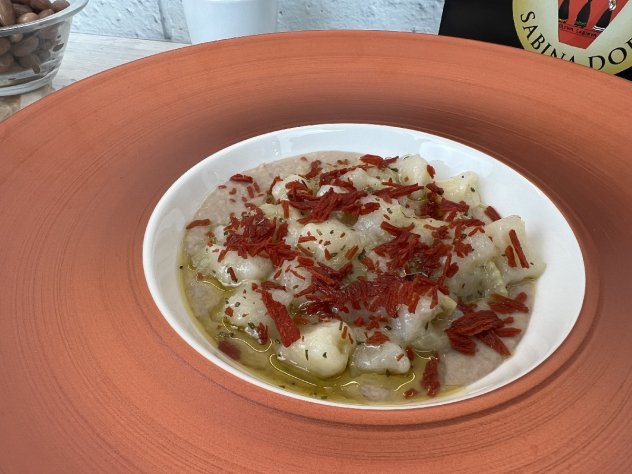
Pizzicotti with Fagiolo gentile di Labro bean cream and aromatic oil
29.6g carbohydrates per 100g
Ingredients for 4 servings
- 250g flour mix for bread, brand Nutrifree**
- 180g water
- 150g dried Fagiolo gentile di Labro beans
- 4g brewer’s yeast
- 50g extravirgin olive oil Sabina DOP
- 20g dehydrated tomato flakes
- 2 shallots
- 2 celery sticks
- 2 bay leaves
- 1 piece of fresh ginger
- 1 sprig of rosemary
- marjoram
- vegetable stock
- grated Pecorino cheese
- 1 pinch of bicarbonate of soda or 1 piece of Kombu seaweed
**Ingredients specific for celiacs
*Ingredients whose labels must read “gluten-free” (or, in Italy, present on Prontuario AIC)
Preparation
- Soak the beans the night before in plenty of water and baking soda or a piece of Kombu seaweed.
- Warm up 50g of extra-virgin olive oil and infuse it with pieces of fresh ginger and marjoram leaves: you will obtain an aromatic oil that you can also use for other preparations.
- Dissolve the brewer’s yeast in a bit of water at room temperature, then pour it into a bowl with the flour and a pinch of salt and add the water required to obtain a smooth, not too hard dough.
- Divide the dough into at least 4 pieces, cover them with a tea towel and leave them to rise for about 20 minutes.
- In a saucepan, brown 1 shallot and 1 chopped celery stick in a little extra virgin olive oil and a sprig of rosemary, then add the soaked beans and bay leaves, cover with vegetable stock and cook (for at least 1 hour). When the beans are cooked, remove the bay leaf and rosemary and whisk to obtain a thick and creamy velouté. Season with salt and pepper.
- In a non-stick pan, put a drizzle of extra virgin olive oil and sauté the remaining shallot and celery finely chopped, season with chopped rosemary and sprinkle with vegetable stock to cook.
- After the dough has risen, bring a pot of water to the boil and lightly salt it. Take the pieces of dough, shape them into thin cylinders of about 1.5cm diameter and pinch them cutting off small knobs to be thrown into boiling water. Continue throwing the dough knobs into the boiling water and let them cook for at least 5 minutes considering that they would not become too cooked. Drain the ‘Pizzicotti’ with a slotted spoon, toss them into the non-stick pan with the chopped shallot and celery and allow them to cream slightly, adding a little cooking water.
- Serve on individual plates, preferably in a soup dish, forming a layer of bean cream topped with Pizzicotti and a dribble of aromatic oil, grated Pecorino cheese and a pinch of dried tomato flakes.
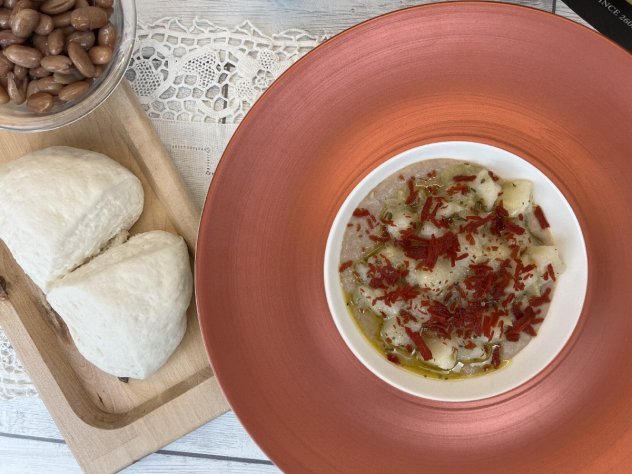
Version with gluten of Pizzicotti with Fagiolo gentile di Labro bean cream and aromatic oil
Replace the flour mix for bread Nutrifree with an equal amount of wheat flour and adjust the amount of water to obtain a bread-like texture.