Tag Archive for: ricette estive

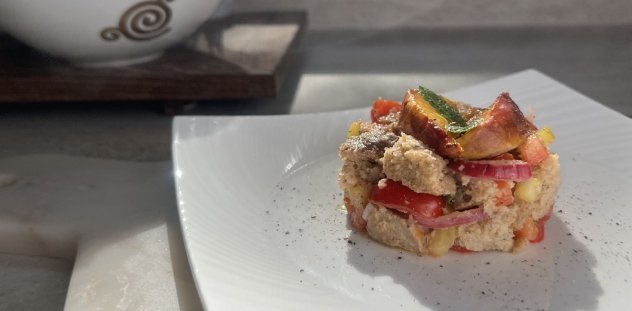
When summer gifts us sweet cherry tomatoes, crisp bell peppers, and fragrant peaches, all you need is a piece of bread to create a colourful, fresh, and complete meal: Summer Vegetable Panzanella.

For this recipe, I used my Crispy Wholemeal Bread, which can be fresh – lightly toasted in a pan – or stale, soaked with water and vinegar. In this version, I started with fresh gluten-free bread and toasted it slightly to let it better absorb the flavours of the vegetables and fruit. With stale bread, Panzanella becomes a perfect anti-waste idea, enhanced by the contrast between the sweetness of grilled peaches and the lively note of mustard and mint.

Perfect as a light lunch, quick dinner, or sharing starter, this Panzanella is rich in fibre, vitamins, and minerals. Plus, it’s an excellent ally for weekly meal planning as it can be prepared in advance: the flavours will meld together, making it even more irresistible.

Looking for another idea with stale bread? Try my Pappa al Pomodoro with Crispy Rinds.
ilaria-bertinelli-panzanella-di-verdure-estive

Summer Vegetable Panzanella

14g carbohydrates per 100g

Ingredients for 4 servings

  • 10-12 ripe cherry tomatoes (220g)
  • 200g gluten-free bread**
  • 1 nectarine or peach (about 160g)
  • 150g yellow bell pepper
  • 150g red bell pepper
  • 70g red Tropea onion (or sweet spring onion)
  • 2 tablespoons lemon juice
  • 1 teaspoon mustard
  • a few fresh mint leaves
  • extra virgin olive oil
  • apple cider vinegar
  • pumpkin seeds
  • salt and pepper

**Ingredients specific for celiacs

*Ingredients whose labels must read “gluten-free” (or, in Italy, present on  Prontuario AIC)

Preparation

  1. Cut the bread into cubes and lightly toast them in a pan with a drizzle of olive oil, then place in a large bowl.
  2. Thinly slice the Tropea onion and marinate it in a small bowl with 3 tablespoons of apple cider vinegar, salt, and pepper for at least 30 minutes.
  3. Dice the bell peppers finely and cut the cherry tomatoes into halves or quarters.
  4. Prepare the dressing by whisking together 4 tablespoons olive oil, 4 tablespoons vinegar, mustard, salt, and pepper.
  5. Slice the peach into wedges and grill them on a hot griddle for 1 minute per side until slightly caramelised.
  6. Assemble the Panzanella by combining the bread, vegetables, onions with their marinade, and the dressing in a large bowl. Mix well and season with torn mint leaves and pumpkin seeds to taste. If the bread seems too dry, add a few tablespoons of water, vinegar, and olive oil.
  7. Let it rest in the fridge for a few hours before serving or prepare it the day before – it will be even more flavourful.
  8. Serve by forming a round disc using a pastry ring, place 1 or 2 peach slices on top with a few mint leaves.
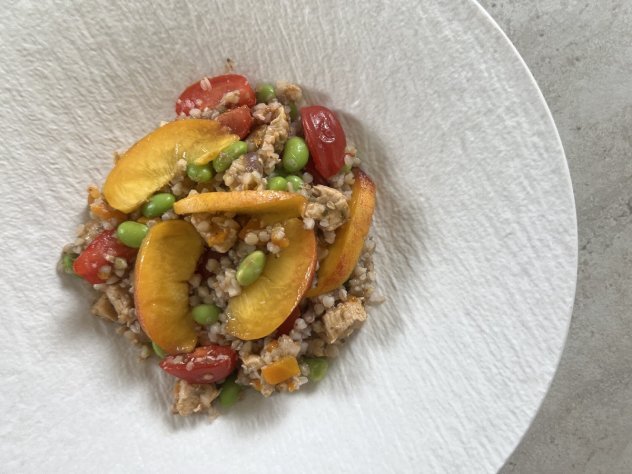
After a morning or evening run, your body needs clean energy and high-quality protein to recover at its best. This Buckwheat Salad with Chicken Ragout and Grilled Peaches is designed exactly for that: a complete meal rich in noble proteins from the chicken and edamame, low glycemic-index carbohydrates thanks to buckwheat, and plenty of vitamins and minerals from the peaches and cherry tomatoes, which refresh and hydrate.

A mix of delicate flavours and different textures that satisfies without weighing you down – perfect for those who love to take care of themselves at the table after a workout.

Discover all the secrets for perfect post-workout recovery with Bianca Balzarini, nutrition coach, with whom I created this very useful e-book.

Buckwheat Salad with Chicken Ragout and Grilled Peaches

8g carbohydrates per 100g

Ingredients for the salad

  • 140 g nectarines or peaches
  • 120 g edamame
  • 100 g buckwheat groats*
  • 10 cherry tomatoes

 Ingredients for the chicken ragout

  • 600 g chicken meat, finely chopped by knife
  • 100 g carrot
  • 40 g onion
  • 30 g celery
  • 1/2 glass of Marsala wine
  • chopped sage, mint, and thyme
  • extra virgin olive oil
  • salt and pepper

*Ingredients whose labels must read “gluten-free” (or, in Italy, present on  Prontuario AIC)

Preparation

  1. Prepare the chicken ragout first. Finely dice the onion, carrot, and celery, and soften them in a saucepan with a drizzle of extra virgin olive oil without letting them fry. Add the chopped herbs and the minced chicken meat.
  2. Mix well until the chicken turns white, then pour in the Marsala wine and let it evaporate. Cover and cook for about 20 minutes. Adjust with salt and pepper.
  3. Meanwhile, boil the buckwheat in lightly salted water and drain when cooked but still al dente.
  4. Blanch the edamame in lightly salted boiling water for 1.5 minutes, then drain and plunge them into cold water.
  5. Halve the cherry tomatoes and add them to the drained buckwheat, then add the edamame and finally the chicken ragout, mixing everything well. Serve with a few slices of nectarine or peach.

ilaria-bertinelli-insalata-di-grano-saraceno-e-pesche-grigliate

Version with gluten of Buckwheat Salad with Chicken Ragout and Grilled Peaches

The recipe is naturally gluten-free, so no adaptation is needed for the version with gluten.

Full speed ahead: Stuffed omelette roll

How many times have you arrived home at dinner time without having any ideas of what to prepare? The Summer omelette roll is a solution to many situations.

In fact, all you need is fresh eggs and a little grated Parmesan cheese to prepare the magical and tasty omelette disc, then you can create the stuffing according to what you find in your fridge and pantry: each time you can serve a roll with a different flavour and colour.

My advice is to always try to use a good amount of vegetables for the stuffing in order to balance the protein- and fat-rich omelette with vitamins and fibre. You can then serve it with a nice slice of wholemeal bread to get the right amount of carbohydrates.

If you are a fan of omelettes, try this Stuffed Omelette.

rotolo-di-frittata-estivo

Summer omelette roll

 carbohydrates per 100g negligible

Ingredients for 4 servings

  • 7 eggs
  • 125g cow’s milk mozzarella
  • 40g Parmigiano Reggiano cheese, grated
  • 1 tomato
  • a handful of lettuce
  • 1 tbsp olive pâté*
  • extra virgin olive oil
  • salt and pepper

**Ingredients specific for celiacs

*Ingredients whose labels must read “gluten-free” (or, in Italy, present on  Prontuario AIC)

Preparation

  1. Beat the eggs well in a bowl with a fork, add the Parmesan cheese and a pinch of salt and pepper.
  2. Put a little oil in a 25-28cm diameter non-stick frying pan and pour in the egg mixture. Cook it over medium heat and, when it has set, turn it over with the help of a lid.
  3. Place the omelette disc on a board and stuff it: spread the lettuce, place the sliced tomato and  mozzarella on top, then the olive pâté evenly distributed.
  4. Roll the omelette tightly, then cut the cylinder in half to serve so that the colours of the ingredients inside can be seen.

Version with gluten of Summer Omelette Roll

The recipe contains only naturally gluten-free ingredients.

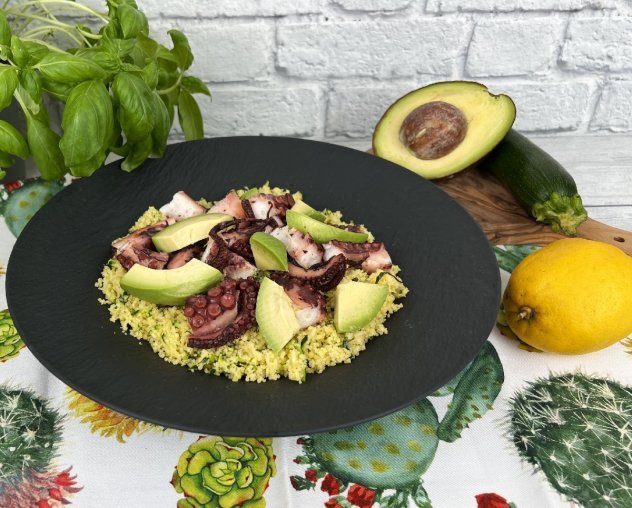
Couscous combined with fish is a great classic, try it in this fresh version for summer: Couscous with octopus and avocado.

You can also indulge in the choice of the type of gluten-free couscous, the Bia company offers a wide range: maize and rice, chickpeas, peas, chickpeas and red lentils, buckwheat are all available options, although with this seasoning I would avoid buckwheat whose characteristic taste would risk covering that of fish.

Couscous combined with fish and vegetables, besides being a source of good fats such as avocado, makes this recipe a perfect one-course meal for lunch or dinner.

If you like couscous in summer, try also Couscous with prawn and courgette curry.

cous-cous-con-polpo-e-avocado

La ricetta del Couscous with octopus and avocado

15.3g carbohydrates per 100g

Ingredients for 4 servings

  • 1kg approx. octopus
  • 200g BIO Corn and rice couscous**
  • 200g courgettes
  • 100g avocado
  • 1 onion
  • 1 carrot
  • 1 celery stalk
  • 1 clove of garlic
  • lemon peel
  • extra virgin olive oil
  • mint
  • parsley
  • salt
  • pepper

**Ingredients specific for celiacs

*Ingredients whose labels must read “gluten-free” (or, in Italy, present on  Prontuario AIC)

Preparation

  1. Cook the octopus in a large saucepan with onion, carrot, celery and garlic, putting a few centimetres of water on the bottom and covering with a lid. Cook over low heat for about 45 minutes.
  2. Prepare the couscous according to the instructions on the packet, i.e. by soaking it with an equal amount of hot water.
  3. Julienne cut the courgettes and sauté them for a few minutes in a non-stick pan with a little oil. Season with salt and pepper.
  4. Separate the couscous well with a fork and season it by adding the courgettes, chopped mint and parsley, grated lemon zest, salt and pepper and a drizzle of extra virgin olive oil.
  5. Assemble the plates by placing the couscous on the bottom and the chopped octopus and avocado on top. Complete to taste with another drizzle of extra virgin olive oil and, if necessary, salt and pepper.

cous-cous-con-polpo-e-avocado

Version with gluten of Couscous with octopus and avocado

Replace the Corn and rice couscous with wheat couscous, while all other ingredients are naturally gluten-free.

I think it has happened to everyone to have bought a product to be used in a recipe and then have the leftover part lying in a corner of the kitchen not knowing what to do with it: this is how Summer vegetarian rolls came about.

I had bought a packet of rice paper with the claim ‘gluten-free’ prominently displayed on the front because I wanted to cook some spring rolls in a moment of nostalgia for trips to Asia, but after using them for this recipe, the leftover sheets stared at me for a long time from the cupboard without me finding a creative and easy way to use them.

Then, obsessed by the heat and the desire for tasty snacks, I came up with the idea of trying to use the rice paper simply wet, so without the need to turn on the cooker or oven: they were so good that I decided to buy another packet of rice paper! Not only that: they will be ready in a matter of minutes!

If you are a fan of oriental flavours, also try the Basmati rice with curry, tuna and peppers.

Involtini-di-verdure-con salsa-di-soia-agrodolce

Summer vegetarian rolls 

 4.5g carbohydrates per roll without sauce

Ingredients for 1 roll

  • 1 sheet of rice paper*
  • 1 sprig garden rocket
  • 1 handful grated carrots
  • 1 tablespoon soft cheese
  • 1 scant teaspoon olive pâté*

Ingredients for the sauce for about 6 rolls

  • 4 spoonfuls rice oil
  • 2 spoonfuls apple vinegar
  • 1 tablespoon maple syrup*
  • 2 teaspoons of soy sauce*

Preparazione

  1. Soak the rice paper briefly in a bowl full of cold water.
  2. Spread the rice paper sheet out on a board and stuff it quickly so that it does not stick to the board itself: form a layer of rocket, lay the soft cheese in a sort of strip in the middle, also spread the olive pate and finally add a handful of grated carrots. Wrap everything up to form a fairly tight roll.
  3. Prepare the sauce for dipping the rolls: put all the ingredients in a small bowl and emulsify well using a fork.
  4. Serve the rolls with a small bowl containing the sauce in which to dip them.

Involtini-di-verdure-con salsa-di-soia-agrodolce

Pasta salads are one of the most popular dishes in summer and every year I like inventing new ones to make a tasty and balanced dish suitable for all occasions.

The protagonists are the Strozzapreti Zero+, organic pasta made with 100% red lentil flour and eggs from free-range hens by the Spinosi pasta factory, a pasta designed to reduce the glycemic index of Italy’s most popular dish while providing a high protein and fibre intake: discover the entire range of gluten-free egg pasta with legume flours to have fun in the kitchen.

This pasta salad proposal is meant to take us tastefully to Greece, using the same ingredients we find in traditional Greek salads, but combined in a slightly different way.

Thanks to the presence of egg in Strozzapreti, the pasta salad has a perfect texture even when cold, which is very unusual in the world of gluten-free pasta, especially with a legume base, so you can enjoy an exquisitely fresh dish that is both healthy and balanced.

If you are looking for more pasta salad ideas, try my Coronation Pasta Salad.

Greek-style Strozzapreti pasta

10.8 g carbohydrates per 100g

Ingredients for 4 servings

  • 250g Strozzapreti Zero+ with red lentil flour*
  • 200g fat free Greek yoghurt
  • 200g cherry tomatoes
  • 100g Greek pitted black olives*
  • 100g Greek feta cheese
  • 70g pickled cucumbers*
  • extra virgin olive oil
  • mint
  • salt and pepper

Preparation

  1. Boil Strozzapreti in lightly salted boiling water for 7 minutes. Drain them, mix them with a drizzle of extra virgin olive oil and leave them to cool.
  2. Cut the cherry tomatoes into 4 wedges and add them to the Strozzapreti together with the black olives, then crumble the feta cheese and mix well.
  3. Prepare a sauce mixing Greek yoghurt with finely chopped pickled cucumbers, season with salt and pepper and pour it over the cold pasta. Complete by adding a few mint leaves and serve.

strozzapreti-alla-greca

As summer officially begins on 21st June, June salads will delight us with the addition of seasonal fruit.

Asparagus continues to be present, which we can enjoy with a mouth-watering cheese cream and plums for a salad that also becomes a green all-in-one dish, great to take to the office or to the pool in a convenient lunch box.

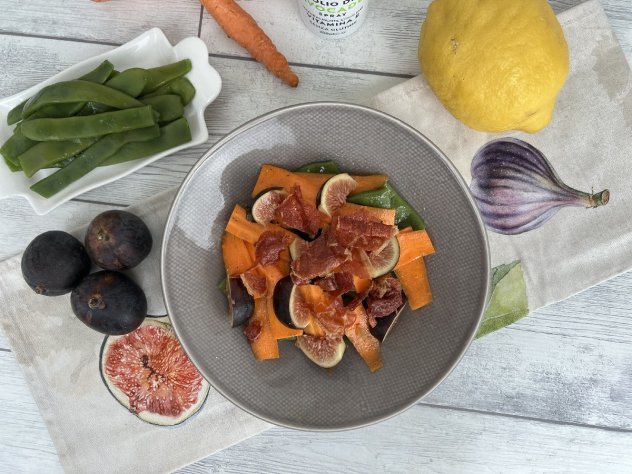
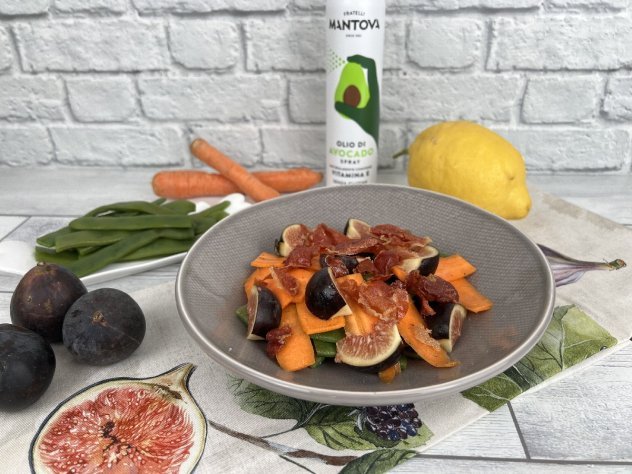
My salad with cooked vegetables features snow peas accompanied by carrots, but above all by the contrast of the sweetness of the figs and the saltiness of the crispy Prosciutto di Parma: as an appetiser, main course or as a one-course meal, the Salad of snow peas and figs will win you over with its explosion of flavours.

The tip I want to share with June salads is the use of spray oil, a very interesting way to dress our dishes. Why?

For two main reasons: the first is that we will use up to 90 per cent less oil for dressing, thus significantly reducing the calorie intake of the salads themselves; the second is that in the canned bag of Fratelli Mantova the oil is stored in the dark and protected from the air, thus guaranteeing ideal preservation.

My choice for these salads is avocado oil containing 100% oil extracted from the pulp of the avocado fruit, rich in vitamin E, with a light and delicate taste and texture.

For more ideas, see also the reinforced salads of May.

Asparagus and plum salad

carbohydrates 7.76g for 1 serving

insalata-di-asparagi-e-prugne

Ingredients for 1 salad

  • 3-4 asparagus
  • 50g plums
  • 30g soy milk*
  • 30g Ricotta cheese
  • 20g Robiola cheese
  • shelled pistachios
  • 1 lemon with edible zest
  • Fratelli Mantova’s avocado oil
  • salt and pepper

*Ingredients whose labels must read “gluten free” (or, in Italy, present on  Prontuario AIC)

Preparation

  1. With a mandoline, slice the asparagus into ribbons and marinate them for at least 15 minutes with a teaspoon of lemon juice, salt, pepper and a splash of avocado oil.
  2. Prepare a cream by mixing ricotta, robiola, grated lemon peel and a grinding of pepper.
  3. Assemble the salad by placing the asparagus ribbons in a salad bowl, the cheese cream, the plums cut into wedges and a sprinkling of shelled pistachios.

insalata-di-asparagi-e-prugne

Snow pea and fig salad

carbohydrates 9.58g for 1 serving

insalata-di-taccole-e-fichi

Ingredients for 1 serving

Preparation

  1. Slice the carrots into ribbons using a mandoline, season them with lemon juice, salt, pepper and a splash of avocado oil, then allow to rest for the time needed to prepare the other ingredients.
  2. Boil the snow peas in boiling salted water until cooked but still firm. Plunge them into cold water, then drain immediately.
  3. Place the Prosciutto slice on a plate and let it crisp up in the microwave or in a non-stick frying pan: in the microwave, set the oven on low power for short periods of time until the desired crispiness is reached; in the frying pan, do not grease the bottom and cook on low heat until crispy.
  4. Assemble the salad by placing the snow beans on the bottom of the salad bowl, the carrot ribbons and a well-washed fig cut into wedges, season with a pinch of salt, pepper and a splash of avocado oil, then finish by adding the crispy prosciutto slice.

insalata-di-taccole-e-fichi

Today I want to take you on a trip to the mountains of the Abruzzo region to discover artisan liqueurs created, as if by magic, by a family of nature and food lovers, which I want to propose to you in this recipe, also lactose-free, to prepare my Prawns with cream of Cannellini beans flavoured with Ratafià.

Artisan liqueurs in the kitchen

Let me introduce the liqueurs by the Scuppoz company starting with the name. The term ‘Scuppoz’ is an onomatopoeic word from Abruzzo that sounds like glasses clinking for toasting and celebrating, but today, Scuppoz is an artisan company that produces liqueurs using what the land of the mountains has to offer: wild herbs, berries and a lot of creative energy.

Before I met the Scuppoz liqueurs, I met Anna, the irrepressible wife of the second generation of herb alchemists whose passion in telling about the battles and challenges of making liqueurs in the hostile mountains of Abruzzo conquered me to the point that I couldn’t but find out about these ‘strong and gentle spirits’, as the motto of the ‘Medicinette’ liqueur collection reads.

Le "Medicinette" dell'azienda Scuppoz

The “Medicinette” collecion by Scuppoz

Ratafià: black cherry liqueur from the hills and Montepulciano wine

For my recipe, I chose the black cherry liqueur Ratafià made with black cherries from the hills and Montepulciano wine, ingredients that give the liqueur a powerful structure. Scuppoz Ratafià can be enjoyed by people with coeliac disease because it is prepared only with red wine, sour cherry juice and alcohol, i.e. without the addition of flavourings (here you will find the AIC rules for choosing gluten-free liqueurs).

Where does the name Ratafià come from? From the Latin expression‘ut rata fiat’, let the deed be ratified, because it was customary to drink this liqueur (prepared by women, but drunk mostly by men) immediately after signing a notarial contract to sanction its validity.

Scuppoz liqueurs are a journey of aromas, flavours and mountain stories, which I have brought to you in this recipe so that even the little ones at home can fully enjoy the experience without taking the alcoholic part for which they will have to wait a while!

And remember to follow Anna’s adventures on social media (https://www.instagram.com/scuppoz_spirits/ ): you won’t regret it!

gamberi con crema di cannellini al ratafia

Prawns with cream of Cannellini beans flavoured with Ratafià

14.10g carbohydrates per 100g

Ingredients for 4 servings

  • 400g red onion from Acquaviva delle Fonti (or Tropea onion)
  • 400g cooked chickpeas
  • 8 prawn tails
  • 2 shallots
  • vegetable stock
  • Ratafià – Scuppoz black cherry liqueur*
  • extra virgin olive oil
  • salt and pepper

**Ingredients specific for celiacs

*Ingredients whose labels must read “gluten-free” (or, in Italy, present on  Prontuario AIC)

Preparation

  1. Slice the red onion and brown it in a non-stick pan with a little oil for a few minutes, then cover with vegetable stock and let it cook without browning.
  2. When the onion is soft and the stock has evaporated, deglaze with 4-5 tablespoons of Ratafià, add salt and pepper and let the liquor thicken for a few minutes, then turn off the heat.
  3. Prepare the Cannellini cream. Put the chopped shallot in a non-stick pan, let it brown, then add the cooked Cannellini beans and let them season for about 5 minutes.
  4. Transfer the Cannellini beans to a blender, add the necessary amount of stock to obtain a thick cream and blend. Season with salt and pepper.
  5. Transfer the onion cooked in Ratafià to a bowl so that you can use the frying pan to cook the prawns: leaving the cooking juices of the onion, cook the prawn tails for a maximum of 2 minutes on each side.
  6. Now assemble the dish: with a ring, form a disc of Cannelli cream, place the Ratafià flavoured onion on top, then 2 prawns and finish with a grinding of pepper and a very light drizzle of oil.

gamberi con crema di cannellini al ratafia

Version with gluten of Prawns with cream of Cannellini beans flavoured with Ratafià

The recipe contains only naturally gluten free ingredients, so no adaptation is necessary for its version with gluten.

When you discover a product that you have never tasted and never heard of before, it is a bit like receiving a gift: so let me introduce Couve Manteiga, the cabbage originally from Brazil, now also grown in Italy, which I have cooked in two mouth-watering versions, namely in Pesto and in Vegetarian rolls with Couve pesto, perfect also for the little ones at home.

Couve Manteiga is a broad-leaved plant that is reminiscent, especially in its use and scent, of kale. Its leaves are beautiful and scented and, turned into pesto, give us a truly inviting emerald green colour, while eaten raw they are crispy and spicy with a typical bitter aftertaste.

la foglia di couve manteiga

Couve Manteiga leaves

It is a vegetable rich in vitamins, minerals and fibre, which is excellent for the diet of those with diabetes as well as for low-calorie diets since 100g contain only 5 carbohydrates and 32 kilo calories.

Personally, I discovered it thanks to the editors of Cuoci Cuoci, a platform where you will find lots of news and recipes, in addition to my proposal of Vegetarian rolls with Couve pesto.

If you want to order Couve, you can contact Azienda Agraria Evangelisti  (gabrieleeva@tiscali.it) or order it by phone at: +39 346-324-5132).

Vegetarian rolls with Couve pesto

21.5g carbohydrates per 100g

Ingredients for the pesto (you will use about half)

  • 200g already blanched Couve Manteiga leaves
  • 30g Pecorino cheese, grated
  • 30g almonds, peeled
  • extra virgin olive oil
  • salt and pepper

Ingredients for the rolls

  • 300g tomato sauce
  • 200g Stelline Massimo Zero pasta**
  • 8 leaves of Couve Manteiga
  • extra virgin olive oil
  • salt and pepper

**Ingredients specific for celiacs

*Ingredients whose labels must read “gluten-free” (or, in Italy, present on  Prontuario AIC)

Preparation of pesto

  1. Wash the Couve Manteiga leaves well, remove the central rib and blanch the rest in boiling salted water for about 1 minute, then with a skimmer remove the leaves from the pot and throw them into cold water.
  2. Place the Pecorino cheese and almonds in a blender and blend to a flour.
  3. Add to this flour, 200g of the blanched and slightly squeezed leaves, a drizzle of oil, a pinch of salt and pepper. Add a little of the cooking water and process in the blender until creamy.

il pesto di couve manteiga

Preparation of rolls

  1. Blanch a further 8 Couve leaves cut in half at the central rib, which you have removed. As with pesto, once blanched, toss the leaves in cold water, then drain and lay them on a tray to dry slightly.
  2. Boil the Stelline pasta in plenty of salted water and, once drained, season them with Couve pesto: the amount prepared is larger than the amount needed to season the pasta, so you can also enjoy the pesto on a slice of toasted bread as an appetiser!
  3. Pour a little oil in a non-stick pan, add the tomato sauce, season with salt and let it cook for a few minutes.
  4. In the meantime, spread out the Couve leaves and stuff them with the Stelline pasta, closing them to form rolls.
  5. Place the rolls in the pan with the tomato sauce, let them season for 5 minutes, turning them and serve hot or warm.

involtini di couve manteiga

Version with gluten of Vegetarian rolls with Couve pesto

Replace the Stelline Massimo Zero pasta with a durum wheat pasta, while no other adaptation is necessary.

How can we combine the pleasure of a burger with a tasty and vegetarian alternative? Try these Gluten-free vegetarian burgers with soybeans and bell peppers.

It is important to remember that burger buns are normally made with butter and milk, so don’t forget to pair this type of bread with a good source of fibre, like these soybean burgers that contain plenty of colourful and tasty vegetables, and a mayonnaise prepared without eggs and dairy products that you can flavour to taste. I was given the recipe of this mayonnaise by my friend blogger Cristiana Curri and I must say that it can be adapted to any preparation, both sweet and savoury!

A nice characteristic of these burgers is that they can be cooked both in a frying pan and in the oven depending on the time available and the desired to turn on the oven. Furthermore, you can always make extra to store in the freezer, ready for unexpected snacks with our children’s friends and schoolmates.

Gluten-free vegetarian burgers with soybeans and bell peppers

17.38g carbohydrates per 100g (about 7.7g carbohydrates per burger)


Ingredients for 12 burgers with soybeans and bell peppers

  • 200g cooked soybeans (I soaked them the night before starting from about 70g dried soybeans, which I cooked for 1 hour)
  • 200g red bell pepper
  • 85g leek
  • 1 egg
  • 30g breadcrumbs**
  • chopped parsley, chilli pepper, paprika, marjoram, salt and pepper
  • 12 small burger buns (you can prepare them using the recipe of Brioche braid increasing slightly the salt, or my recipe of Panini per hamburger with Massimo zero flour)

Ingredients for the egg-free mayonnaise and to complete

  • 100g high oleic sunflower oil
  • 50g soy milk*
  • paprika
  • 1 pinch of salt
  • leaves of lettuce

**Ingredients specific for celiacs

*Ingredients whose labels must read “gluten-free” (or, in Italy, present on  Prontuario AIC)

Preparation of burgers

  1. Chop the leek and put it in a non-stick frying pan with a dribble of oil; add the red pepper cut in pieces and cook the vegetables until soft. When almost ready, add the cooked soybeans and flavour with spices and salt to taste. Put everything in a food processor and blend to a mixture (leave some pieces inside). Allow to cool down, then add egg and breadcrumbs and mix well.
  2. You can cook the burgers in two ways: in a frying pan or in the oven. To cook them in a frying pan, grease it a bit with olive oil and use a metal ring of the desired shape to form the burgers putting a tablespoon of mixture inside the rings. After a minute, remove the rings and complete cooking the burgers on both side. To cook the burgers in the oven, shape them using a metal ring directly on the baking tin lined with slightly greased parchment paper, then bake the burgers in a convection oven pre-heated at 180°C for about 15 minutes.

Preparation of vegetable mayonnaise

  1. Pour the soy milk in a tall glass and blend with a hand blender pouring the oil in a trickle. Complete adding salt and paprika to taste.
  2. Assemble the burgers cutting the buns in half, putting the soybean burgers, the mayonnaise and lettuce.

Burger di soia e peperone

Version with gluten of Burger with soybeans and bell peppers

Replace the gluten-free buns with standard buns, whereas no adaptation is necessary for burgers and mayonnaise.