Tag Archive for: dolci senza glutine

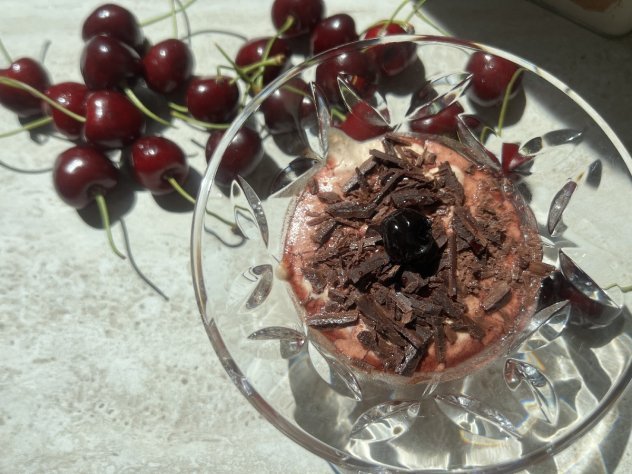
Cherry Mousse with Dark Chocolate is a simple and refreshing dessert, perfect for summer but also ideal all year round for lovers of chilled sweets.
It can easily be adapted with other seasonal fruits: peaches, apricots, berries or plums work wonderfully in place of cherries, allowing us to update the recipe month by month, following nature’s rhythm.

To reduce the fat content, I used fat-free Greek yogurt to balance out the cream.
Thanks to the natural sweetness of the fruit and the other ingredients used, there’s no need to add sugar: a few drops of sweetener are more than enough, depending on your personal taste and dietary needs.

This recipe is quick and easy, requires no baking, and is always visually impressive. It keeps well in the fridge and is perfect as a light and elegant summer dessert or an afternoon treat.

If you enjoy spoon desserts, here’s another summer idea: my Peach pudding with coconut and mint with no added sugars.

Cherry mousse with dark chocolate

 14.79g carbohydrates per 100g using liquid sweetener

Ingredients for 10-12 servings

  • 380 g cherries (pitted weight)
  • 250 g cream
  • 250 g fat-free Greek yogurt
  • 70 g dark chocolate*
  • 15 g sheet gelatin*
  • 10–12 Luxardo cherries in syrup*
  • Liquid sweetener* or sugar, to taste

*Ingredients whose labels must read “gluten-free” (or, in Italy, present on  Prontuario AIC)

Preparation

  1. Soak the gelatin in cold water, then melt it in 2 tablespoons of warm cream and let it cool slightly.
  2. Blend the cherries (or your chosen fruit) and set aside.
  3. Whip the cream and gently fold in the yogurt. Add the blended cherries and the dissolved gelatin. Sweeten to taste, then pour the mixture into individual serving bowls or glasses and refrigerate for a few hours to set.
  4. Before serving, top with chopped dark chocolate and one maraschino cherry with a little syrup (approx. 9 g per portion).

Ilaria-bertinelli-mousse-di-ciliegie-con-cioccolato-fondente

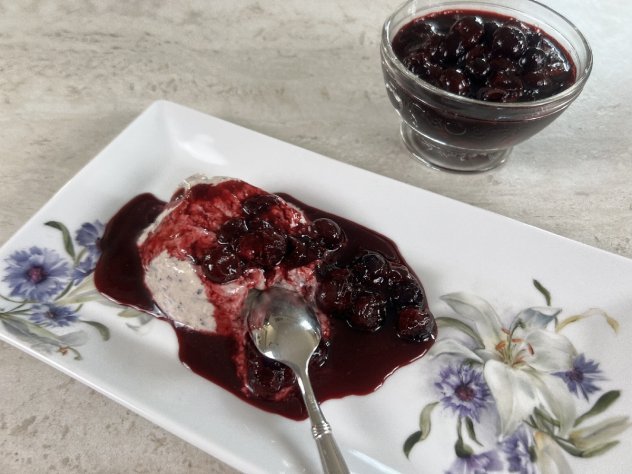
Blueberry panna cotta with fruit-only sugars is a light and naturally sweet dessert, perfect for those looking for a delicious yet mindful treat. Made without added sugars and with the option to use plant-based milk and cream, this recipe is also ideal for those who are lactose intolerant or follow a vegan diet.

What makes this dessert so special are the dates—rich in fiber, minerals, and natural sugars with a low glycemic index—and the blueberries, true health allies thanks to their high content of antioxidants, vitamin C, and anthocyanins, compounds that support microcirculation and skin wellness.

Its low carbohydrate content makes it a great dessert or snack for anyone who needs to manage their blood glucose levels, like us: enjoy every spoonful of this fresh, colorful, and versatile treat!

If you’re looking for more desserts with no added sugars, try our Peach pudding with coconut and mint.

Blueberry panna cotta with fruit-only sugars

10.73g carbohydrates per 100g

Ingredients for 7 servings

  • 500g blueberries
  • 500g plant-based* or dairy milk
  • 250g plant-based* or dairy cream
  • 100g dates
  • 20g sheet gelatine*
  • lemon juice

*Ingredients whose labels must read “gluten-free” (or, in Italy, present on Prontuario AIC)

Preparation

  1. Soak the gelatine sheets in cold water until soft.
  2. Heat a small amount of milk and stir in the softened gelatine until fully dissolved.
  3. In a tall container, combine the milk, cream, pitted dates, and half the blueberries. Blend with an immersion blender until smooth, then add the dissolved gelatine.
  4. Pour the mixture into 7 silicone moulds (for unmoulding later) or into small serving glasses. Refrigerate until set.
  5. Meanwhile, cook the remaining blueberries in a non-stick pan with lemon juice until they release a thick, bright sauce. Let cool.
  6. Unmould the panna cotta or serve in glasses, topping with the blueberry sauce.

ilaria-bertinelli-panna-cotta-ai-mirtilli-con-solo-zuccheri-della-frutta

Pears and chocolate are a great classic that makes our mouth water just by thinking of their flavour. If we add to this the fact that this Pear and chocolate pudding is super light, we have found a solution to satisfy our craving for sweets without destroying our effort to follow a balanced diet.

This Pear and chocolate pudding is not only a perfect dessert, but it is also excellent as an alternative breakfast or mounth-watering afternoon snack.

Do you know where this recipe comes from? From chatting with a customer of my greengrocer’s who was buying pears to cook this pudding, which I wanted to make even more irresistible by completing it with a chocolate cream!

budino-di-pere

Pear and chocolate pudding

carbohydrates 20,82g per 100g with sweetener

Ingredients for the pudding for 4 servings

  • 500g pears, peeled and cored
  • 40g thick coconut milk or water
  • 20g brown rice flour*
  • sweetener* or sugar

Ingredients for the chocolate ganache

  • 70g bitter chocolate
  • 40g plant or cow’s milk
  • toasted hazelnuts

**Ingredients specific for celiacs

*Ingredients whose labels must read “gluten-free” (or, in Italy, present on Prontuario AIC)

Preparation

  1. Dice the pears and cook them in a pan with coconut milk or water: if you use water, you won’t have the pleasant coconut note.
  2. When pears start di undo, add the rice flour, stir well and blend to a cream: adjust sweetness adding sweetener or sugar to taste.
  3. Pour into 4 little glasses and put in the refrigerator.
  4. Meanwhile, prepare the chocolate ganache chopping the bitter chocolate and pouring on top of it the milk brought to a boil; stir with a whisk to a smooth and even cream.
  5. At the time of serving, take the glasses out of the refrigerator and complete with the chocolate ganache: if the chocolate has become too hard, warm it up to make it runny and garnish with chopped hazelnuts.

The cold season stimulates the desire for hot drinks that immediately bring us a sense of contentment and pleasure, especially when accompanied by a simple, light and old-fashioned sweet such as this Coffee-flavoured oil doughnut.

A few ingredients, a non-stick mould and the handy release agent spray are all you need for a guaranteed result.

You can use the Coffee-flavoured oil doughnut either as a dessert at the end of a meal, accompanying it with a cream of your choice, a scoop of ice cream, a spoonful of jam or a small glass of coffee liqueur, or enjoy it at breakfast accompanied by a refreshing and invigorating yoghurt.

More breakfast ideas? Try the Brioche braid.

Coffee-flavoured oil doughnut

46g carbohydrates per 100g

ciambella all'olio

Ingredients

  • 125g sugar
  • 100g potato starch*
  • 100g wholemeal rice flour*
  • 100g water
  • 100g coffee
  • 100g seed oil
  • 50g corn starch*
  • 3 eggs
  • 16g baking powder*
  • cinnamon powder
  • tonka bean

**Ingredients specific for celiacs

*Ingredients whose labels must read “gluten-free” (or, in Italy, present on  Prontuario AIC)

Preparation

  1. With an electric whisk, whip the eggs with the sugar until white and frothy, add the oil in a trickle, the warm coffee and water.
  2. Very slowly incorporate starch, flour and baking powder by sifting and continuing to stir.
  3. Flavour with cinnamon and grated tonka bean. Grease and flour a mould and pour in the mixture.
  4. Bake in a static oven preheated to 180°C for about 40 minutes.

What could be more satisfying than a dessert prepared without the addition of sugar and with two of the most delicious ingredients par excellence, chocolate and cherries? The answer is: this Chocolate and cherry ganache, the pleasure of a dessert without the (or perhaps it is better to say ‘with very little’) guilt!!!

Yes, because while this fantastic recipe does not include added sugar and cream, it does not mean that it is calorie-free because it is made with avocado and chocolate, but at the same time, it is calories from nutritionally valuable foods.

Avocado is in fact rich in mono-unsaturated fatty acids (therefore good for our organism), antioxidants (it is no coincidence that it is used in many cosmetic products), vitamins, fibres and mineral salts, so much so that it has an anti-inflammatory function on our body: a true natural supplement. Moreover, for some years now, its cultivation has been spreading to Sicily and Sardinia, making its consumption much more environmentally sustainable for us Italians.

As far as chocolate is concerned, the choice you have at your disposal is very wide, so buy your favourite chocolate considering a cocoa percentage of no more than 55-60% (otherwise you will feel the need to add some sugar to the preparation) and perhaps lactose-free for those who are lactose intolerant: in short, Chocolate and Cherry Ganache is really the dessert for everyone, considering that with the right chocolate it is also suitable for vegans.

Also, since the cherry season is, alas, always too short for such a delicious fruit, indulge yourself with any other fruit to make the accompanying sauce, perhaps following the recipe for Panna cotta with berries.

Chocolate and cherry ganache with no added sugar

 18.83g carbohydrates per 100g

Ingredients for chocolate ganache for 4 servings

  • 200g avocado pulp (approx. 1 avocado)
  • 120g chocolate with no added sugar*
  • 25g bitter cocoa*
  • water, if needed
  • edible flowers for decoration (optional)

*Ingredients whose labels must read “gluten-free” (or, in Italy, present on  Prontuario AIC)

Ingredients for the cherry sauce

  • 400g cherries
  • the juice of 1/ 2 lemon
  • water

Preparation 

  1. Melt the chocolate in a bain-marie or microwave, then let it cool down.
  2. Put the avocado pulp in the blender with the cocoa powder and melted chocolate: blend to obtain a smooth and fluffy cream adding a few tablespoons of cold water if it is too hard.
  3. Stone the cherries and place them in a non-stick pan with the lemon juice and 3 tablespoons of water over high heat so that the cherries release some of their juice: this will take about 5 minutes.
  4. Assemble the cups by placing a portion of chocolate ganache and the cherries with their cooking liquid as a complement: you can serve them cold or warm as you like.

ganache di cioccolato e ciliegie

Version with gluten of Chocolate and cherry ganache with no added sugar

This recipe contains only naturally gluten-free ingredients, so no adaptations are necessary.

What is your favourite cake? How many times have you been asked that! And I never know how to answer, but on second thought, the Fresh Fruit Tart with naturally gluten-free flours could take the podium.

So this year I decided to publish the recipe on the occasion of my birthday, because, as it is often happens to who cook, we end up making our own birthday cake! For a garden party, you can also opt for Tartlets with strawberries.

Here’s how to cook it and two different finishes that have delighted the family on different occasions.

Fresh fruit tart with naturally gluten-free flours

50.31g carbohydrates per 100g of tart

Ingredients for the shortbread

  • 150g wholemeal rice flour*
  • 100g almonds, peeled
  • 100g sugar
  • 80 g butter
  • 60g corn starch*
  • 40g potato starch*
  • 2 eggs
  • 8g baking powder*
  • grated lemon rind
  • 1 pinch of salt

Ingredients for the pastry cream

  • 500g semi-skimmed milk
  • 150g sugar
  • 40g corn starch*
  • 5 egg yolks
  • a bit of vanilla from the pod
  • rind of 1 lemon (optional)

Ingredients to complete

  • 400g mixed fruit
  • jelly spray for tarts*

*Ingredients whose labels must read “gluten-free” (or, in Italy, present on  Prontuario AIC)

Preparation

  1. Blend the almonds to obtain a flour, then place it in a bowl or planetary mixer with all the other shortcrust pastry ingredients. Mix quickly and when you have obtained a homogeneous dough, place it in the refrigerator to rest for about 30 minutes wrapped in cling film.
  2. Meanwhile, prepare the custard. Put the milk in a small saucepan on the stove with the lemon peel (if you like) and bring it almost to the boil. In another container, lightly beat the egg yolks and the sugar with a whisk and when they start to whip up, add the cornflour, making care not to let lumps form, and the vanilla bean tip.
  3. Very slowly and always stirring with the whisk, start pouring the boiling milk over the mixture and, once it has all been poured in, return it to the heat until the cream starts to thicken. It is important that you remove the cream from the heat as soon as it starts to thicken, otherwise it will be too hard once it has cooled. Let cool and remove the lemon peel.
  4. Take the shortcrust pastry out of the refrigerator, roll it out on a sheet of baking paper to line a baking tin 24cm in diameter or larger (depending on the thickness you like for the tart, you might have some shortcrust pastry left over that you can use to make breakfast biscuits – delicious!). To blind bake the tart, place a sheet of baking paper filled with beans or rice on top of the shortcrust base and bake for about 15 minutes in a static oven preheated to 180°C. Then remove the baking paper with the beans or rice and finish baking the shortcrust base.
  5. Now compose the cake. Pour the custard over the base, decorate with the washed and cut fruit and sprinkle the jelly over the fruit so that it does not turn brown. Keep the tart in the fridge until it is ready to be eaten and… enjoy the celebrations!

crostata di frutta fresca

Version with gluten of Fresh Fruit Tart with natural flours

The recipe contains only naturally gluten free ingredients, so no adaptation is necessary for its version with gluten.

Easter is approaching and with it the traditions of Easter sweet and savoury recipes with which we celebrate it. This year I thought I would share with you the recipe for a biscuit that I love and that was the star of the course dedicated to Italian Biscuits: I am talking about the gluten-free and traditional  Canestrelli  recipe that you can give to your loved ones with the certainty of making them happy, a perfect gift also for Father’s Day.

The Canestrelli recipe between legends and truths

Canestrelli biscruits are so famous and popular that they need no introduction, yet not many people know their history and preparation techniques.

Their origin dates back to the Middle Ages and even then they were so popular to be depicted on Genovini, i.e. the coins minted from 1252 onwards by the Genoese Republic. The value of this biscuit was linked not only to its taste, but also to the ingredients used, namely white flour and butter, which in the hinterland of Genoa, in the Val di Trebbia, were true rarities, so much so that Canestrelli were used for centuries as currency.

And the name Canestrello is also linked to notoriety as it first appeared in an official document in 1576 that reported on a hapless muleteer stabbed and robbed of a ‘basket’ of biscuits (basket being ‘canestro’ in Italian, hence the name of the biscuits), confirming the value that was attributed to this product.

Precious ingredients and… magical mistakes

While it was considered scandalous to ‘waste’ white flour and butter on a biscuit, there is no shortage of legends to explain why hard-boiled egg yolks are used in the Canestrelli dough instead of fresh eggs (in fact, shortcrust pastry made with hard-boiled egg yolks is a specific type of dough that results in cakes with a crumbly, silky texture).

One such story tells of a woman baker who, on the very day she had a large order of biscuits to prepare, did not wake up as usual. Her husband, in an attempt to help her, had hard-boiled all the eggs to have them ready for breakfast the following days. Having no time to buy more eggs, the baker decided to use the hard-boiled yolks to prepare the biscuit dough: these biscuits were so successful that they became famous throughout the region.

As is often the case in Italy, typical recipes have countless local and even family variants, and Canestrelli are no exception, so although they are recognised as Traditional Food Products (PAT) of Liguria, ingredients and preparation may vary slightly from area to area.

But what are their main characteristics?

Definitely the daisy shape that goes from a diameter of about 10cm with scalloped edges to smaller diameters to be eaten in one bite. The central hole is proportionate to the diameter, while the thickness is always quite high, at least 7 millimetres. The colour is barely golden, made even lighter by the icing sugar with which the surface is dusted.

So, are you now feeling like turning on the oven and baking some biscuits? Do you have some paper bags ready to wrap them for daddy or as a gift for Easter? Have fun with my gluten free Canestrelli!

Canestrelli senza glutine

The typical flower shape of Canestrelli

Gluten free and traditional Canestrelli

carbohydrates 64.31g per 100g canestrelli without icing sugar on the surface

Ingredients for 23 biscuits

  • 120g butter
  • 100g gluten free flour mix for bread, brand BiAglut** (wheat flour for a version with gluten)
  • 100g potato starch or corn starch*
  • 50g icing sugar*
  • 2 yolks of hard-boiled eggs
  • grated rind of 1/2 lemon
  • 1 pinch of salt
  • 1 egg white for brushing
  • icing sugar* to complete

**Ingredients specific for celiacs

*Ingredients whose labels must read “gluten-free” (or, in Italy, present on  Prontuario AIC)

Preparation

  1. Put the eggs in boiling water and boil them for 8 minutes; shell them and extract the hard-boiled yolks.
  2. Place the flour, icing sugar, soft butter, starch and sifted egg yolks in a bowl or planetary mixer and start mixing, add the pinch of salt and grated lemon zest, then knead until smooth and firm. Initially the dough will seem dry, but once the butter is mixed in, it will be soft and smooth. Cover the mixture with cling film and put in the refrigerator for 1 hour.
  3. Roll out the shortcrust pastry to a thickness of approx. 7mm-1cm, then cut the biscuits using the flower-shaped cookie mould with the hole in the centre. Brush them with egg white.
  4. Put Canestrelli on a baking tin covered with parchment paper and bake them in a static oven preheated to 170°C for about 15-20 minutes without allowing them to get brow: it is important not to bake them too much!
  5. Let them cool down, then dust with icing sugar.

The mould for cutting Canestrelli 

Version with gluten of Canestrelli

Replace the gluten-free flour with an equal amount of wheat flour.

On 13 January, Parma celebrates its patron saint, Saint Ilario, and, as in all Italian cities, there is a recipe inextricably linked to the city’s patron saint: in the case of Parma, the recipe is Scarpette di Sant’Ilario biscuits, which you can also easily prepare in a gluten free version.

Why a biscuit with this unusual shape?

History has it that Bishop Ilario from Poitiers (circa 315-369 A.D.) found himself passing through the city of Parma on a cold, snowy winter day wearing only a pair of old, worn-out shoes. Pitifully, a cobbler gave him a pair of new shoes and the next day, in his workshop, Ilario’s old shoes had turned into golden shoes. So it is that the shoe-shaped biscuits richly decorated with coloured icing want to celebrate the Saint on the anniversary of his death, and the generosity of the people from the Emilia region.

Images of the saint can be found in several monuments in the city, including a fresco in the pendentives of the cathedral dome by Correggio and a fresco inside the Church of San Giovanni by Parmigianinoboth of which you cannot miss if you visit my city.

Decorating these biscuit shoes is therefore a tradition, especially to the delight of children who do not go to school on the holiday and thus have time to engage in such a creative activity together with their parents on a somewhat unconventional festive day. To hear the story of St. Ilario in detail, I tell it to you in this episode of Santi comuni.

The only difficulty you might encounter? Finding the mould to cut the biscuits for which you will probably have to resort to some specialised shops in Parma, such as Dalla A allo Zuccheroin the heart of the city to tempt us with everything you need to have fun with sweets.

Naturally, given the abundant use of sugar for decoration, the Scarpette di Sant’Ilario are not very suitable for habitual consumption, especially for those with diabetes: so be careful not to get carried away either by the decorations (which is why I have not been able to tell you the carbohydrate value of the decorated biscuits because it can vary very significantly depending on the decoration made), or by the consumption of these little gems which are a real temptation!

Biscotti a forma di scarpette di sant'Ilario

Scarpette di Sant’Ilario biscuits

carbohydrates of the shortbread 67g per 100 g of baked biscuits

Ingredients

  • 250g gluten free flour mix for bread, brand BiAglut**
  • 250g brown rice flour*
  • 200g softened butter
  • 170g sugar
  • 3 eggs
  • 8g baking powder*
  • grated lemon rind
  • 1 pinch of salt 

Ingredients for the hard icing

  • 150g icing sugar*
  • 25g pasteurised egg white
  • food colours* 

Ingredients for the soft icing

  • 140g icing sugar*
  • 25g pasteurised egg white
  • food colours*

**Ingredients specific for celiacs

*Ingredients whose labels must read “gluten-free” (or, in Italy, present on  Prontuario AIC)

Preparation

  1. Put the flour, butter, sugar, salt and eggs in a mixing bowl. Mix well, then add baking powder and grated lemon zest. Cover with a piece of cling film and leave to rest for the time needed to prepare the icing, about 10-15 minutes.
  2. Take bowls with rounded bottoms, one for each colour you wish to prepare (you can also follow my YouTube video to help you with the preparation of the icings). For the hard white icing, place 25g of pasteurised egg white in a bowl and gradually add 150g of icing sugar, stirring with a spoon so that the mixture is smooth and even. For the soft icing, repeat exactly the same procedure, adding 140g sugar.
  3. Starting with the white bases, add the necessary colours and sugar to obtain the various colours, both hard and soft.
    The hard icing will be used with a pastry bag fitted with a nozzle with a hole of about 1mm, while the soft icing will be dispensed using a teaspoon and the rounded tip of a knife.
  4. Cover all icings with cling film in contact with the surface until use.
  5. Roll out the short pastry with a rolling pin to a thickness of about 5mm, cut the biscuits into the shoe shape, place them on a baking tin covered with parchment paper and bake them in a convection oven preheated to 160°C for 10 minutes.
  6. When the biscuits are completely cooled, form the outline with one of the hard icings, white or coloured, placed in the pastry bag; cover the surface of the biscuit inside the outline using the soft icing to be spread with the help of a rounded tip of a knife so that no gaps are left. Let the icing dry for at least 15 minutes before making other decorations with a pastry bag on the soft icing to avoid colour smudging. To enjoy making other similar biscuits, also check out this recipe.

 Scarpette di sant'ilario

Version with gluten

Replace the gluten-free flour with wheat flour and mix with 2 whole eggs and 1 yolk.


A Celebration Sacher because for the first time in my life I will not be at home for Christmas and this makes me feel really strange.

The atmosphere is unusual because we have decided not to light up and decorate our house, which will remain closed during the holidays, but this makes me a little bit sad even though the reason for being away is a real dream: a trip we have been looking forward to for years!  So, to recreate a hint of Christmas atmosphere, I thought of one of my favourite cakes and dressed it up for the occasion: my gluten-free Celebration Sacher! And the Sacher is definitely one of my favourite cakes, as you can also see from my Lovers’ Sacher.

It was definitely a more quiet celebration, but at least we got a taste of the ‘sweetest’ and most anticipated holiday of the year since I don’t know what I will be able to bring to my family’s table on 24 December on the other side of the Atlantic Ocean!

Wishing you a peaceful Christmas and a sparkling start to the New Year, I hope to bring home some nice surprise recipes for 2020. See you soon!

Celebration Sacher

40.31g carbohydrates per 100g


Ingredients for the cake

  • 150g dark chocolate*
  • 150g butter
  • 150g sugar
  • 100g wholemeal rice flour*
  • 5 eggs
  • 50g rice starch*
  • a bit of vanilla from the pod
  • a pinch of salt

Ingredients for filling and coating

  • 450g apricot jam*
  • 150g dark chocolate*
  • 95g fresh cream
  • 30g water

*Ingredients whose labels must read “gluten-free” (or, in Italy, present on  Prontuario AIC)

Preparation

  1. Melt the chocolate and butter in a bain-marie or microwave and mix well so that the two ingredients are perfectly incorporated. Let the mixture cool down.
  2. Separate the egg yolks from the egg whites and whip the latter until stiff with a pinch of salt, then set aside.
  3. Add sugar, then one yolk at a time to the chocolate mixture, stirring with a whisk. Add the sifted flour and vanilla, continuing to stir so that no lumps form.
  4. Finally fold in the stiffly beaten egg whites.
  5. Pour the mixture into a 24cm diameter cake tin lined with wet and squeezed parchment paper so that it adheres well to the sides of the tin, tap the tin on a surface to release any air bubbles and bake in a static oven preheated to 180°C for 40 minutes. Remove the cake from the oven and allow it to cool. The cake will be fairly compact: this is typical of Sacher, which needs the apricot jam and the chocolate coating to express itself at its best.
  6. Cut the cake in half horizontally. Spread 250g of apricot jam on the lower half, then cover it with the top half. Pour the remaining jam into a thick-bottomed saucepan with the water, place it on the heat and allow it to melt slightly, then strain it through a thin sieve to obtain a kind of thick, smooth juice. Use this apricot juice to thoroughly wet the surface and sides of the chocolate cake with the help of a brush (you may have some leftover juice).
  7. Prepare the ganache for coating the cake by chopping the chocolate well and pouring over it the boiling cream heated in a saucepan.
  8. Mix well to obtain a smooth and uniform cream, let it cool and cover the cake with the help of a smooth-bladed knife or spatula. Decorate your Sacher with Christmas decorations of your choice. Sacher is even softer when eaten after 5 or 6 hours, or even the day after since the apricot jam will have been perfectly absorbed by the cake.

sacher-senza-glutine

Version with gluten of Celebration Sacher

The recipe contains only naturally gluten-free ingredients, so no adaptation is necessary for its version with gluten.

For a foodie, what could be nicer than getting to know the products of an area? This is the purpose of Talent for Food, the event designed to put bloggers from all over Italy in contact with companies producing and processing food, wines, spirits and liqueurs from the provinces of Padua and Treviso, of which Valdobbiadene, recently recognised as an intangible heritage of Unesco, is the best known expression.

Talent for Food: discovering the products of an area

How can you say no to such an extraordinary opportunity? So, I too submitted my application to participate in the initiative and after a few weeks I received the Mystery Box containing the 18 products to choose from to make a recipe… mouth-watering!

You can imagine that every time I embark on these wonderful adventures, there is always the fear that I cannot use most of the ingredients because of the presence of gluten… so bated breath until the mysterious box arrives!

I must admit that the first impact was… shocking, do you know why? Because the box had been damaged in transit, causing a bag of Agugiaro&Figna Molini organic wholemeal flour (one of their mills is just a stone’s throw from my house!) to break, which, of course, covered everything like a fine snowfall. What to do? Panic in the ranks! In the end, I decided to separate the gluten free products and subject them to a nice bath in the garden to try to remove all the flour from the waterproof packaging to avoid contamination of their contents when opened.

Having overcome my fear, I was finally able to ‘see’ the gifts from the land of Padua that I could use. Are you curious? Drum roll and here are the products to choose from for my gluten free proposal:

Agricola Grains high oleic sunflower oil https://www.agricolagrains.it/

Bbovis granulated stock preparation https://www.bovis.it/

Dialcos rice and quinoa pasta https://www.dialcos.it/

Molino Favero lentil flour http://www.molinofavero.com/

Goppion Native Coffee http://www.goppioncaffe.it/

Italdroghe saffron powder https://www.italdroghe.it/

Lazzaris strawberry mostarda https://www.lazzaris.com/

Serbosco artichoke cream https://www.serbosco.it/

Well organic stock https://www.brodowell.it/

My first idea of making a pie with a lentil crust, rice and quinoa pasta topped with artichoke sauce and saffron cream vanished in front of the packet of Dialsì pasta, which I found damaged, thus contaminated by the broken bag of wheat flour. I had to find an alternative quickly.

What would you have made with these ingredients?

What would you have prepared with these ingredients considering that the regulation required at least 5 ingredients to be used amongst the ones provided? One of my favourite desserts immediately came to mind: saffron panna cotta! All that was left for me to do was to think about how to use at least four more ingredients in the preparation and, despite the somewhat daunting premise, it only took a moment to come up with my dessert!

Saffron panna cotta is a bit of a workhorse of mine and I usually serve it by simply accompanying it with crumbled amaretti biscuits (super quick version), so I simply had to replace the amaretti biscuits with something similar, but more interesting: a lentil flour crumble. For this crumble, pre-cooked lentil flour and sunflower oil were two perfect allies. In fact, pre-cooked flour allows for better workability and texture, as well as shorter cooking times, and the high oleic oil is a perfect substitute for butter, but allows you to use half the amount.

Another ingredient I chose was coffee. I love coffee and its aroma paces my days, generally associating it with moments of pleasure and tranquillity, so pairing it with a dessert, the quintessential expression of pleasure, was almost a must. A nice coffe pot on the stove and voilà: I could replace water with coffee in a chocolate icing to obtain a coffee-flavoured chocolate sauce for an unforgettable treat.

The unexpected touch to the dish is the spicy sweetness of the strawberry Mostarda: Lazzaris often accompanies my cheese-based desserts (of which, as a good daughter of Parmigiano Reggiano producers, I am very fond), but never before has it accompanied a classic dessert: I’d say it passed the test very well!

Before I unveil the recipe, I’ll give you a smile: I decided to prepare the panna cotta in single portions (whereas I usually prepare it in a large version to be sliced) because I wasn’t sure about the plating…coffee chocolate cream on top or underneath? crumble on top or on the side? and the strawberry? So, with all these doubts, I prepared 8 single portions and set the whole family to work, asking each person to serve their favourite version of this panna cotta. We had a lot of fun and, above all, we ate up all the panna cotta we had prepared as a test! Fortunately, I kept a few aside to photograph and our favourite version is the one I’m sharing with you!

These are the official hashtags for Talent For Food: #talentforfood, #t4f, #aifbt4f, #aifb and this is anoter Panna cotta if you like this type of dessert.

Saffron Panna cotta with lentil crumble and strawberry mostarda

Panna cotta 20.22g carbohydrates per 100g

Crumble 46.83g carbohydrates per 100g

Coffee flavoured chocolate sauce 31g carbohydrates per 100g

Preparation time: 35 minutes

Cooking times: 30 minutes

Rest time: 6 hours

Ingredients for 8 servings

  • 500g fresh cream
  • 250g milk
  • 150g sugar
  • 2 sachets of saffron powder
  • 15g gelatine sheets* (3 sheets)

Ingredients for the crumble (you will have some left over to use as granola for breakfast)

  • 55g red lentil flour Bio Miks*
  • 40g almonds
  • 40g Demerara dark sugar
  • 30g wholemeal rice flour*
  • 20g organic high oleic sunflower oil Agricola Grains
  • 1 egg
  • 15g pine nuts

Ingredients for the coffee flavoured chocolate sauce

  • 150g fresh cream
  • 100g Goppion Coffee
  • 100g sugar
  • 75g dark chocolate*
  • 50g bitter cocoa powder*

Ingredients to complete

  • Lazzaris strawberry mostarda*

*Ingredients whose labels must read “gluten-free” (or, in Italy, present on  Prontuario AIC)

Preparation

  1. Soak the gelatine in cold water.
  2. Mix cream, milk and sugar and put them on the stove in a saucepan. Stir to melt the sugar and when the mixture is hot, add the saffron and squeezed gelatine; stir until the gelatine is completely dissolved.
  3. Leave to cool and pour the mixture into 8 single-portion moulds of the desired shape. Put the moulds in the refrigerator for Panna cotta to solidify and cool for at least 6 hours.
  4. Prepare the crumble. Coarsely chop the almonds, leaving some whole, and mix them with the lentil flour, rice flour, pine nuts and sugar; then add the oil and egg to moisten the mixture and when it forms large crumbs, spread them out on a sheet of parchment paper and bake in a static oven preheated to 180°C for about 15 minutes or until the crumbs are golden brown. Remove from the oven and allow to cool.
  5. Prepare the chocolate sauce. Prepare 100g of coffee; put the cocoa powder in a small pan, pour in the coffee and stir with a whisk to obtain a lump-free cream, then add the cream and sugar and put on the heat for 5 minutes, stirring well with the whisk (if you have a thermometer, the temperature should be between 70 and 80 degrees, if you do not have a thermometer, keep the mixture just below the boiling point).
  6. Turn off the stove and add the lightly chopped chocolate, stirring with a whisk so that it melts completely, then leave to cool, stirring occasionally. Once the sauce has cooled, keep it in the refrigerator until it is time to serve the Panna cotta.
  7. To complete the Panna cotta, unmould each single-portion on the serving platter, top with the coffee chocolate sauce, sprinkle with crumble and complete with a Lazzaris strawberry.
Gli ingredienti della mia ricetta per Talent for Food

The ingredients of my recipe for Talent for Food

Version with gluten of Saffron Panna cotta with lentil crumble and strawberry mostarda

The recipe contains only naturally gluten-free ingredients or ingredients bearing the gluten free wording, so no adaptation is necessary for its version with gluten.