Tag Archive for: traditional italian recipes

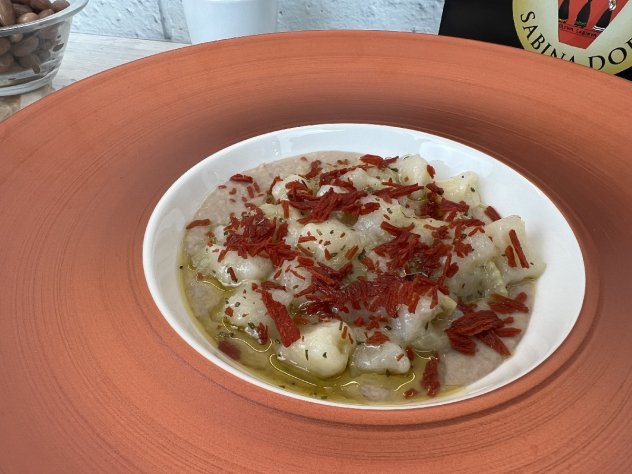
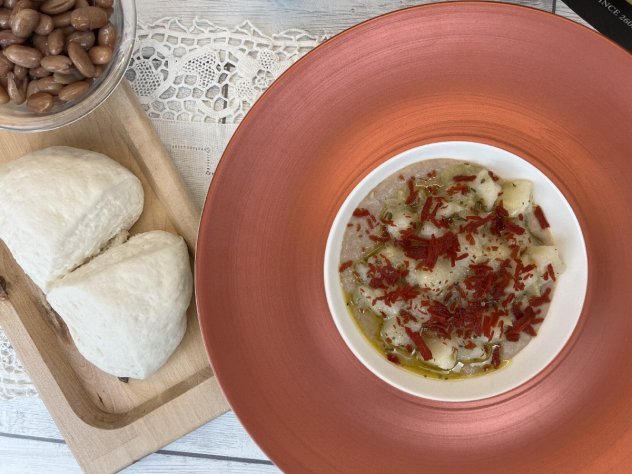
Would you like an original idea coming from the tradition of a land very dear to me? Here are the Pizzicotti with Fagiolo gentile di Labro bean cream topped with an irresistible oil flavoured with ginger and marjoram.

Once again, the gastronomic journey is in Lazio thanks to the Rieti Chamber of Commerce, which sent us the local ingredients to prepare this recipe with a very special ingredient: Fagiolo gentile di Labro a Slow Food Presidium and a product included in the list of Italian Traditional Agricultural Products (PAT in Italian).  It is a variety of bean that grows exclusively in the Avanzana Valley at the foot of the village of Labro, in the province of Rieti. It is light brown in colour and its fame is due to the tenderness of its skin and its delicate, sweet taste: the adjective ‘gentile’, i.e. gentle, by which it is called derives from such sweetness.

This traditional dish from Lazio is a perfect meal from a nutritional point of view, so why not use it as a holiday season dish? It is perfect both to brighten up banquets and to alternate meals characterised by the presence of meat and fish with a vegetarian recipe rich in plant protein and plenty of fibre.

To discover the great classic of the Rieti land, read my article and recipe for the The Perfect Amatriciana.

pizzicotti-con-crema-di-fagioli-di-labro

Pizzicotti with Fagiolo gentile di Labro bean cream and aromatic oil

29.6g carbohydrates per 100g 

Ingredients for 4 servings

  • 250g flour mix for bread, brand Nutrifree**
  • 180g water
  • 150g dried Fagiolo gentile di Labro beans
  • 4g brewer’s yeast
  • 50g extravirgin olive oil Sabina DOP
  • 20g dehydrated tomato flakes
  • 2 shallots
  • 2 celery sticks
  • 2 bay leaves
  • 1 piece of fresh ginger
  • 1 sprig of rosemary
  • marjoram
  • vegetable stock
  • grated Pecorino cheese
  • 1 pinch of bicarbonate of soda or 1 piece of Kombu seaweed

**Ingredients specific for celiacs

*Ingredients whose labels must read “gluten-free” (or, in Italy, present on  Prontuario AIC)

Preparation

  1. Soak the beans the night before in plenty of water and baking soda or a piece of Kombu seaweed.
  2. Warm up 50g of extra-virgin olive oil and infuse it with pieces of fresh ginger and marjoram leaves: you will obtain an aromatic oil that you can also use for other preparations.
  3. Dissolve the brewer’s yeast in a bit of water at room temperature, then pour it into a bowl with the flour and a pinch of salt and add the water required to obtain a smooth, not too hard dough.
  4. Divide the dough into at least 4 pieces, cover them with a tea towel and leave them to rise for about 20 minutes.
  5. In a saucepan, brown 1 shallot and 1 chopped celery stick in a little extra virgin olive oil and a sprig of rosemary, then add the soaked beans and bay leaves, cover with vegetable stock and cook (for at least 1 hour). When the beans are cooked, remove the bay leaf and rosemary and whisk to obtain a thick and creamy velouté. Season with salt and pepper.
  6. In a non-stick pan, put a drizzle of extra virgin olive oil and sauté the remaining shallot and celery finely chopped, season with chopped rosemary and sprinkle with vegetable stock to cook.
  7. After the dough has risen, bring a pot of water to the boil and lightly salt it. Take the pieces of dough, shape them into thin cylinders of about 1.5cm diameter and pinch them cutting off small knobs to be thrown into boiling water. Continue throwing the dough knobs into the boiling water and let them cook for at least 5 minutes considering that they would not become too cooked. Drain the ‘Pizzicotti’ with a slotted spoon, toss them into the non-stick pan with the chopped shallot and celery and allow them to cream slightly, adding a little cooking water.
  8. Serve on individual plates, preferably in a soup dish, forming a layer of bean cream topped with Pizzicotti and a dribble of aromatic oil, grated Pecorino cheese and a pinch of dried tomato flakes.

pizzicotti-con-crema-di-fagioli-di-labro

Version with gluten of Pizzicotti with Fagiolo gentile di Labro bean cream and aromatic oil

Replace the flour mix for bread Nutrifree with an equal amount of wheat flour and adjust the amount of water to obtain a bread-like texture.

September is one of the months in which the Giarratane onions, the sweet, extra-large Sicilian onions that are perfect for stuffing and preparing in a thousand ways, are harvested: try these Giarratane onions stuffed with Legumotti.

The Giarratana onion is an onion grown in the area of the municipality of Giarratana in the south-east of Sicily. Its size is variable and a single bulb can weigh up to 3 kg. Its main characteristic is sweetness, which makes this onion particularly popular and part of the traditional Italian produce (P.A.T.) list created by the Ministry of Agriculture and Forestry.

Precisely because of its sweetness, this onion is also often eaten raw, but it is excellent with all types of cooking: boiled, grilled and baked au gratin.

Stuffed with my beloved Legumotti topped with lots of vegetables and a touch of melting cheese, it is a perfect main course for people affected by diabetes and coeliac disease for both lunch and dinner.

If you like Legumotti, try them in the Legumotti salad with caramelised Tropea onion.

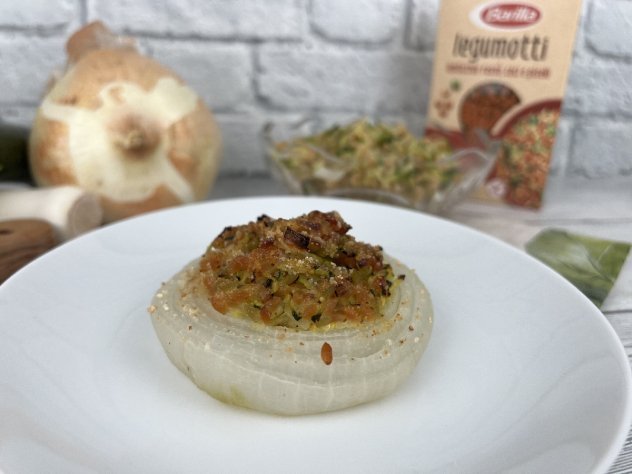
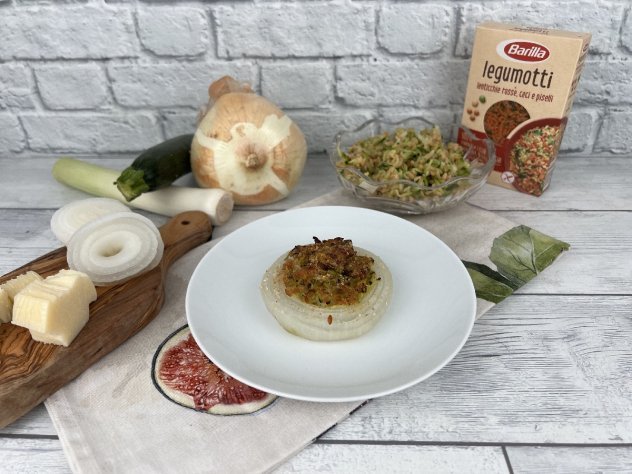
Giarratane onions stuffed with Legumotti

carbohydrates 13.13g per 100g

cipolle-giarratane-ai-legumotti

Ingredients for 4 servings

  • 4 Giarratane onions of about 350g each
  • 180g courgettes
  • 150g leek
  • 120g Barilla Legumotti*
  • 50g sharp Provolone cheese
  • breadcrumbs*
  • extra virgin olive oil
  • oregano
  • salt and pepper

**Ingredients specific for celiacs

*Ingredients whose labels must read “gluten free” (or, in Italy, present on  Prontuario AIC)

Preparation

  1. Peel and trim the Giarratane onions then cut them in half horizontally.
  2. Put a pan of water on the heat, when it comes to the boil throw in the Giarratane onions cut in half and boil them for 5 minutes. Drain them with a skimmer and lay them on a cutting board to dry.
  3. Chop the leek very finely and sweat it in a non-stick pan with a little oil. Add grated sharp Provolone cheese and stir to melt.
  4. Use, if you like, the water used to blanch the onions to cook the Legumotti for 9 minutes, then drain and throw them into the non-stick pan with the vegetables; stir and season with salt and pepper.
  5. Remove some internal layers of the onions to form a hollow for the filling; use the inside of the onions for any other preparation (sauces, onion stuffing, caramelised onions, etc.).
  6. Stuff the emptied onions with the Legumotti, sprinkle with breadcrumbs and a drizzle of oil and put in a convection oven preheated to 200°C for 15 minutes to gratin.
  7. Serve the stuffed onions warm.

cipolle-giarratane-ai-legumotti

Do you know how the recipe for gluten-free Carnival Fried Tortelli came about? By pure chance, while experimenting with doughs for the Cicerchiata cooked live with the Rieti and Viterbo Chamber of Commerce! Among various combinations of flour, egg and sugar, having obtained a beautiful smooth and firm dough, I thought I would try making Tortelli with plum jam.

The result? Delicious fried Carnival Tortelli! And it’s a good thing I had written down all the weights of the ingredients, otherwise I would have missed out on the doses for an ideal dough for a traditional recipe that has always been prepared in my family (usually in a version with gluten) for Mardi Gras.

Here are other recipes you can prepare for Carnival: Cicerchiata, Fried cream e Krapfen with jam.

Gluten-free Carnival Fried Tortelli

54g carbohydrates per 100g

Ingredients for 10 Tortelli

  • 150g plum jam*, very firm
  • 100g gluten-free flour mix for bread, brand BiAglut**
  • 100g gluten-free bread flour, brand Mix B Schär**
  • 2 eggs
  • 20-30g milk (add it gradually)
  • 25g sugar
  • 15g butter
  • lemon rind
  • sunflower seed oil for deep frying

Preparation

  1. Pour the eggs into a bowl, beat them with a fork together with the sugar, add the soft butter and lemon zest. Gradually incorporate the flour, stirring with a fork until the mixture is firm enough to knead with your hands. Add enough milk to obtain a firm mixture, then transfer to a cutting board and knead with your hands until you obtain a smooth, homogeneous and non-sticky dough.
  2. Cover it with cling film and let it rest for 15 minutes.
  3. Roll out the dough to a thickness of about 5mm, place a teaspoon of very firm plum jam on top of the pastry, cover with another layer and cut out the Tortelli with the mould provided. Continue until everything is used up.
  4. Heat the seed oil to a temperature of 170-180°C and deep-fry a few Tortelli at a time, using a skimmer to flip them so that they brown evenly. Drain them well on paper towels.

tortelli-dolci-di-carnevale

Version with gluten of Carnival Fried Tortelli

Replace the BiAglut and Schär flours with equal amounts of 00 wheat flour and adjust the amount of milk added.

This idea for gluten-free carnival sweets came to me from my friends at the Rieti and Viterbo Chamber of Commerce, who, keeping alive an initiative conceived during the Covid-19 pandemic, organised FB lives from theOsteria Le Tre Porte in Rieti to publicise the products of the area by sending to bloggers and journalists throughout Italy the ingredients to prepare various dishes including Cicerchiata.

When I received the information about the recipes we would prepare together, I had not imagined that Cicerchiata would be a dessert. Instead, in the province of Rieti, it is the traditional Carnival dessert inspired by Campania’s ‘Struffoli‘. The traditional form is that of a garland, which is obtained by pouring the sweets into a doughnut mould, while I’m proposing a mini-serving version so as not to be tempted to eat too much of it.

Given the fundamental role of honey in this recipe, it seems that the spread of Cicerchiata is linked to the development of bee-keeping in this area of Italy, while the name is presumed to derive from the legume grass peas of which the sweet balls of dough reproduce the shape and colour, so Cicerchiata would be a nice ‘stack of grass peas’.

Like many Carnival sweets, Circerchiata symbolises regeneration through its circular shape, the frying that turns a cold dough into a delicacy, and the vitality of honey and colourful decorations.

A tip for those of us who have to be careful with both fried food and simple sugars? Form very small balls, just like dried chickpeas, and reduce the amount of honey to the minimum necessary to hold the precious compositions together.

Here are a few more ideas for Carnival: Krapfen with jam e Fried cream.

cicerchiata

Cicerchiata

60g carbohydrates per 100g without candied fruit and coloured sprinkles

Ingredients

  • 160g flour mix for bread, brand BiAglut**
  • 2 eggs + 15g egg white
  • 100g honey
  • 40g brown rice flour*
  • 25g sugar
  • 20g butter
  • lemon rind
  • slivered almonds*
  • candied fruit*
  • coloured sprinkles*

**Ingredients specific for celiacs

*Ingredients whose labels must read “gluten-free” (or, in Italy, present on  Prontuario AIC)

Preparation

  1. Pour the eggs into a bowl, beat them with a fork together with the sugar, add the soft butter and lemon zest. Gradually incorporate the flour, stirring with a fork until the mixture is firm enough to knead with your hands. Transfer everything onto the work surface and continue kneading with your hands until you obtain a smooth and homogeneous dough, similar to fresh pasta.
  2. Divide the dough into small portions, form them into sticks of dough having a diameter of about 8mm as for making Gnocchi, then cut them into chunks no more than 8mm-1cm long. Round the pieces of dough with your fingers to form small balls.
  3. Heat the seed oil to a temperature of 170-180°C and deep fry a few balls at a time. When they are golden brown, drain them well and let them cool on kitchen paper.
  4. Meanwhile, pour the honey into a large pan and heat it gently for a few minutes. When it has browned slightly, turn off the heat and add the fried balls, stirring to coat them evenly. Finally, add the almonds and sprinkles, taking care to keep some aside for decoration. Mix again, pour the mixture into the desired moulds, garnish with the almonds and sprinkles kept aside and serve.

Cicerchiata

Version with gluten of Cicerchiata

Replace BiAglut flour and rice flour with 250g wheat flour 00 and add 30g sugar instead of 25g.

This is my second (and last… at the moment) recipe from the Umbria stop of the ‘20 di cambiamento  project”. Roveja polenta with anchovies (polenta that here takes the name Farecchiata or Pesata) tells of a pulse, much less known than the Castelluccio Lentils, indeed I would say almost unknown outside the area where it is grown: Roveja.

Unknown foods

Roveja is a small pea-like pulse with a pod that, at first green in colour, turns dark purple as it matures; it is harvested between the end of July and the beginning of August. The dried pulse is brown in colour.

La roveja essiccata, materia prima di zuppe e farine

Dried Roveja, the raw material for soups and flours (photo: La Repubblica)

In ancient times, Roveja was cultivated on the entire Umbria and Marche Apennine ridge, from the Colfiorito Plateau to the Gran Sasso mountain through Cascia and Castelluccio, thanks to its resistance to low temperatures and its low need for water for cultivation.

Although it was the mainstay of the diet of shepherds and farmers, especially in soups prepared also with other pulses, Roveja almost completely disappeared from the market after World War II due to its tiring and unprofitable cultivation methods.

To save this cultivation from oblivion, in 2006 Slow Food turned it into a Presidium involving a few farmers from the Valnerina valley in the municipality of Cascia who continue to cultivate it to this day very similarly to lentils. Roveja can be eaten fresh or dried, or it can be stone ground to obtain a flour with a slightly bitter aftertaste, and it is the main ingredient in our recipe.

Il fiore della roveja

Roveja flowers (photo: Bikers in cresta)

A recipe for ’20 di cambiamento’

And this is my second recipe (the first recipe was Ricotta and lentil tart) because I tasted Roveja for the first time in my life thanks to a trip to Castelluccio and to my friend and blogger Cristiana Curri (https://blog.giallozafferano.it/chicchecris/). It is a pulse and therefore it does not contain gluten, but it does contain complex carbohydrates which, by absorbing a lot of water during the digestive process, contribute to a gradual rise in blood sugar levels, keeping them constant and avoiding peaks.

I also like the fact that the Polenta is flavoured (given the difficulty of finding salt in these mountains, it is no coincidence that unsalted bread is also common here) by an anchovy sauce, the fish that used to be preserved in salt, becoming long-lasting, nutritious and practical to transport, which is present in many recipes from areas that are far from the sea precisely because of these extraordinary characteristics (just think of Piedmont’s Bagna Cauda).

It is an iconic dish of Umbrian cuisine and by preparing Roveja polenta, we will therefore be doing ourselves a favour, but above all we will be helping to safeguard the biodiversity of this area and to keep alive a product and its centuries-old tradition. Furthermore, you will only need four ingredients to prepare a truly amazing dish… in addition to water!

A little anecdote: when I first made Roveja Polenta, I cooked a lot of it because I did not know its yield, texture and taste. In fact, I ended up with a whole dish full of Polenta I hadn’t even touched! The next day, when the Polenta was perfectly firm, I used it to prepare a gratin by alternating layers of Roveja Polenta, stewed Tropea red onion, chopped celery and grated salted ricotta cheese… a delight!

La polenta di roveja con le alici pronta per essere gustata

Roveja Polenta with anchovies   

7.78g carbohydrates per 100g

 Ingredients for 4 servings

  • 450g water
  • 100g Roveja flour*
  • 60g extra virgin olive oil
  • 10 fillets of salted anchovies or anchovies in oil
  • 1 clove garlic
  • coarse salt for the water
  • celery (optional)

*Ingredients whose labels must read “gluten-free” (or, in Italy, present on  Prontuario AIC)

Preparation

  1. Put the water on the stove and bring it to the boil; add salt to the water and when the salt has completely dissolved, remove the pot from the heat just long enough to pour in the Roveja flour, stirring with a whisk so that no lumps form.
  2. Put the pot back on the heat and stir the mixture frequently with a wooden spoon so that it does not stick to the bottom. Cook the Polenta over low heat for about 25 minutes.
  3. Meanwhile, prepare the sauce. If you decide to use salted anchovies, remove the salt on the surface with a sharp knife and remove the central bone. For convenience, I opted for anchovy fillets in oil. Then put the oil in a small pan, add the garlic cut in half and let it brown slightly, then remove it and add 6 anchovy fillets and let them melt.
  4. When the Polenta is ready, assemble the dishes by making a layer of Polenta, season it with the anchovy sauce and finish with 1 whole rolled anchovy fillet. I decided to serve the Polenta accompanied by celery sticks to give the recipe a fresh touch and make it more suitable for the warm season.


Il piatto finito con i pochi ingredienti necessari per prepararlo

Version with gluten of Roveja Polenta with anchovies

The recipe contains only naturally gluten free ingredients, so no adaptation is necessary for its version with gluten.