For the ninth stage of my Giro d’Italia in 20 Gluten-Free Recipes, I arrived in Tuscany with one of the most iconic sweets of the region: gluten-free Cantucci.
My friend Valentina suggested this recipe to me. She told me that, after her daughter was diagnosed with celiac disease, there were many traditional dishes she thought about, but Cantucci remain among the recipes she misses most. They are the biscuits traditionally served with coffee, enjoyed at the end of a meal with friends, or offered to guests as a symbol of hospitality and conviviality.
Perhaps not everyone knows that what we commonly call Cantucci are also known as Biscotti di Prato. The latter is the name of the traditional recipe that originated in the city of Prato and was made famous in the nineteenth century by the Mattei biscuit bakery. Over time, the term Cantucci gradually became more widespread and is now the name by which these biscuits are known throughout Italy and around the world.
The name Cantuccio also has a curious history. Contrary to what is sometimes believed, it does not refer to the double-baking process, but probably derives from the Latin cantellus, meaning “small corner” or “small piece”. This is thought to refer to the shape of the biscuit, obtained by cutting the dough log diagonally before the second bake.
The double baking, on the other hand, is what makes these biscuits so special. After the dough is first baked as a log, it is sliced while still warm and returned to the oven. This process gives Cantucci their characteristic dry, crisp texture, which has made them famous and makes them perfect to enjoy with Vin Santo, as tradition dictates in Tuscany.
For my version, I chose to use naturally gluten-free flours, making these biscuits easy to prepare at home and perfect to offer to friends or family members with celiac disease, so that everyone can enjoy the same sweet treat together.
And this is precisely the thread running through my journey across the Italian regions: showing that the pleasure of sharing food should never have barriers.
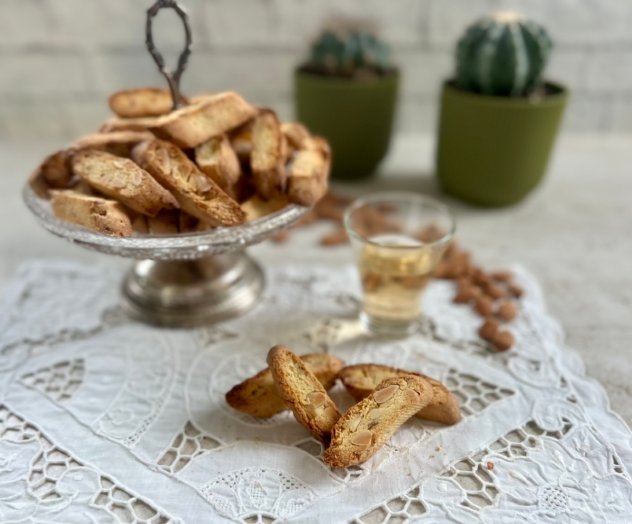
Gluten-free Cantucci
63.6 g carbohydrates per 100 g
Ingredients for approximately 40 pieces
- 180 g whole-grain rice flour*
- 150 g sugar
- 150 g shelled almonds, with and without skin
- 120 g butter
- 50 g potato starch*
- 50 g almond flour*
- 35 g fine whole-grain corn flour*
- 2 eggs
- just under ½ teaspoon xanthan gum*
- 1 pinch of salt
- rice flour* for dusting
**Ingredients specific for celiacs
*Ingredients whose labels must read “gluten free” (or, in Italy, present on on Prontuario AIC)
Method
- Work the whole-grain rice flour with the butter, then add the remaining dry ingredients and continue mixing with your fingertips. Finally, add the eggs and mix until you obtain a smooth, homogeneous dough.
- Coarsely chop the almonds and incorporate them into the dough.
- Using a little rice flour to prevent sticking, shape the dough into 5 logs approximately 4 cm wide. Place them on a baking tray lined with parchment paper and bake in a preheated conventional oven at 200°C (390°F) for 14 minutes.
- Remove the logs from the oven and let them cool slightly for about 10 minutes. Cut them diagonally into slices just over 1 cm thick, then place the biscuits back on the baking tray and return them to the oven at 180°C (355°F) for another 12–14 minutes.
- Remove the Cantucci from the oven and allow them to cool completely before serving. Store them in a tightly sealed biscuit tin.