Tag Archive for: ricette vegane

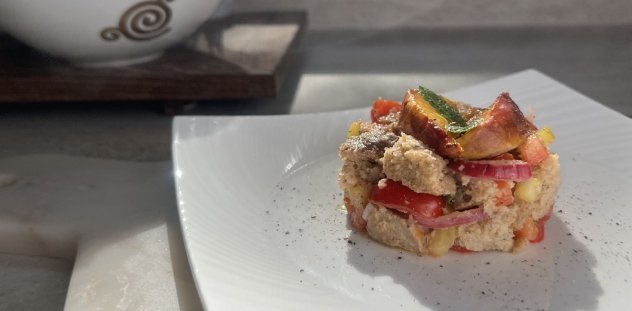
When summer gifts us sweet cherry tomatoes, crisp bell peppers, and fragrant peaches, all you need is a piece of bread to create a colourful, fresh, and complete meal: Summer Vegetable Panzanella.

For this recipe, I used my Crispy Wholemeal Bread, which can be fresh – lightly toasted in a pan – or stale, soaked with water and vinegar. In this version, I started with fresh gluten-free bread and toasted it slightly to let it better absorb the flavours of the vegetables and fruit. With stale bread, Panzanella becomes a perfect anti-waste idea, enhanced by the contrast between the sweetness of grilled peaches and the lively note of mustard and mint.

Perfect as a light lunch, quick dinner, or sharing starter, this Panzanella is rich in fibre, vitamins, and minerals. Plus, it’s an excellent ally for weekly meal planning as it can be prepared in advance: the flavours will meld together, making it even more irresistible.

Looking for another idea with stale bread? Try my Pappa al Pomodoro with Crispy Rinds.
ilaria-bertinelli-panzanella-di-verdure-estive

Summer Vegetable Panzanella

14g carbohydrates per 100g

Ingredients for 4 servings

  • 10-12 ripe cherry tomatoes (220g)
  • 200g gluten-free bread**
  • 1 nectarine or peach (about 160g)
  • 150g yellow bell pepper
  • 150g red bell pepper
  • 70g red Tropea onion (or sweet spring onion)
  • 2 tablespoons lemon juice
  • 1 teaspoon mustard
  • a few fresh mint leaves
  • extra virgin olive oil
  • apple cider vinegar
  • pumpkin seeds
  • salt and pepper

**Ingredients specific for celiacs

*Ingredients whose labels must read “gluten-free” (or, in Italy, present on  Prontuario AIC)

Preparation

  1. Cut the bread into cubes and lightly toast them in a pan with a drizzle of olive oil, then place in a large bowl.
  2. Thinly slice the Tropea onion and marinate it in a small bowl with 3 tablespoons of apple cider vinegar, salt, and pepper for at least 30 minutes.
  3. Dice the bell peppers finely and cut the cherry tomatoes into halves or quarters.
  4. Prepare the dressing by whisking together 4 tablespoons olive oil, 4 tablespoons vinegar, mustard, salt, and pepper.
  5. Slice the peach into wedges and grill them on a hot griddle for 1 minute per side until slightly caramelised.
  6. Assemble the Panzanella by combining the bread, vegetables, onions with their marinade, and the dressing in a large bowl. Mix well and season with torn mint leaves and pumpkin seeds to taste. If the bread seems too dry, add a few tablespoons of water, vinegar, and olive oil.
  7. Let it rest in the fridge for a few hours before serving or prepare it the day before – it will be even more flavourful.
  8. Serve by forming a round disc using a pastry ring, place 1 or 2 peach slices on top with a few mint leaves.
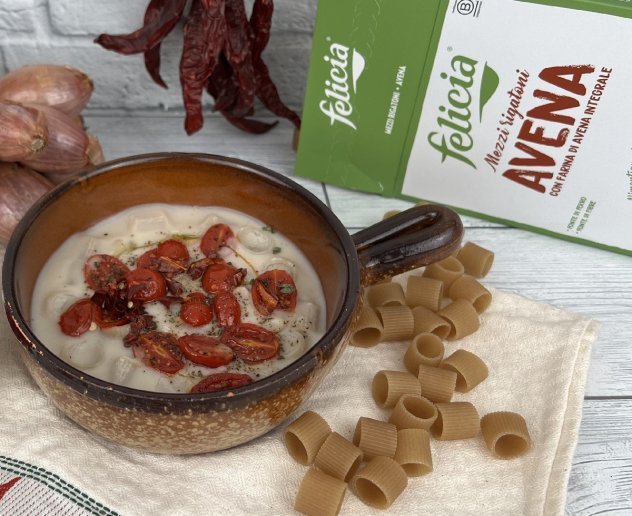
Can you think of those simple flavours that spark memories?  Oat pasta with cannellini beans is the perfect combination of traditional flavours and a touch of novelty.

One of the most typical dishes of Italian cuisine is in fact Pasta e fagioli (pasta and beans), a recipe often prepared with Borlotti beans and the addition of lard or bacon, which in the past were useful to give the necessary energy to face the hard work in the fields.

Instead, this version of Pasta e fagioli uses cannellini beans combined with oat pasta, where the wheat protein, gluten, is replaced by the high protein content in oat. Remember that beans are a valuable source of complex carbohydrates, plant proteins, fibre and are cholesterol-free, so the consumption of legumes is always a valuable ally in a balanced diet.

The flavour variation is the presence of sautéed cherry tomatoes with aromatic herbs that transform a classic taste into a fresher, juicier one.

If you love beans and tradition, try my Pisarei e fasò.

Oat pasta with cannellini beans

carbohydrates 13.63g per 100g

Mezzi-rigatoni-di-avena-ai-cannellini

Ingredients for 4 servings

  • 500g boiled cannellini beans (about 180g dry beans)
  • 240g cherry tomatoes
  • 140 g Oat pasta Felicia**
  • 1 shallots
  • 2 cloves of garlic
  • extra virgin olive oil
  • dried sweet pepper or Crusco pepper
  • bay leaf
  • oregano
  • thyme
  • rosemary
  • chilli pepper
  • salt and pepper

**Ingredients specific for celiacs

*Ingredients whose labels must read “gluten free” (or, in Italy, present on  Prontuario AIC)

Preparation

  1. Soak the cannellini beans for at least 12 hours, then boil them slowly in plenty of water with the addition of a bay leaf and, if available, a piece of Kombu seaweed to facilitate the beans’ future digestibility. Drain the beans and keep the cooking water.
  2. Cut the cherry tomatoes in half and sautée them for a few minutes on high heat in a non-stick pan with a little extra virgin olive oil, a clove of garlic cut in half, a chilli pepper and chopped herbs.
  3. Put a drizzle of extra virgin olive oil in a pan, brown a finely chopped shallot and a clove of garlic and add the cooked cannellini beans, cover with plenty of cooking water or vegetable stock and leave them to take on flavour for 10 minutes.
  4. Keep a few tablespoons of cannellini beans aside and blend the rest with an immersion blender, then reassemble the bean soup.
  5. Cook the oat pasta in plenty of salted water, drain and pour it into the cannellini soup, then complete the dish: place the pasta and beans on individual plates, complete with the herb flavoured tomatoes, a grinding of pepper, a drizzle of oil and some chopped dried sweet pepper or Crusco pepper.

Version with gluten of Oat pasta with cannellini beans

The recipe contains only naturally gluten-free ingredients.

What vegetables await you in our April salads? Cauliflower, peas and leek will be the stars with the red touch of strawberries: find out how to prepare them.

Let’s start with an uncommon use of cauliflower: raw. Have you ever tried it? You will be surprised to discover that it is sweet and has a much more delicate smell than when cooked. It is in fact during cooking that the typical sulphurous smell develops, which often makes cauliflower not liked, especially by children. In the first salad, cauliflower is grated to make a tasty, micronutrient-rich couscous with lots of flavour and few calories.

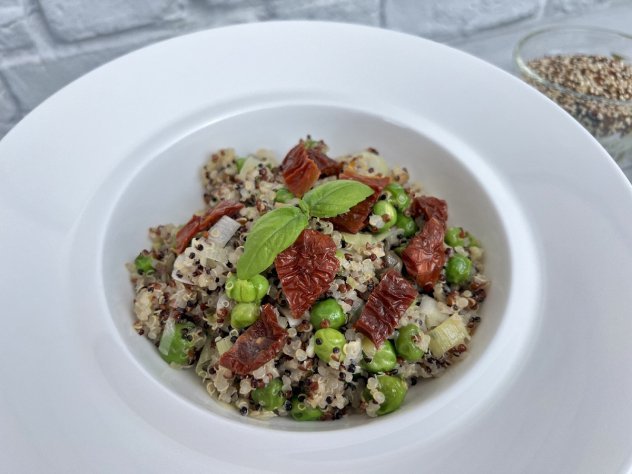
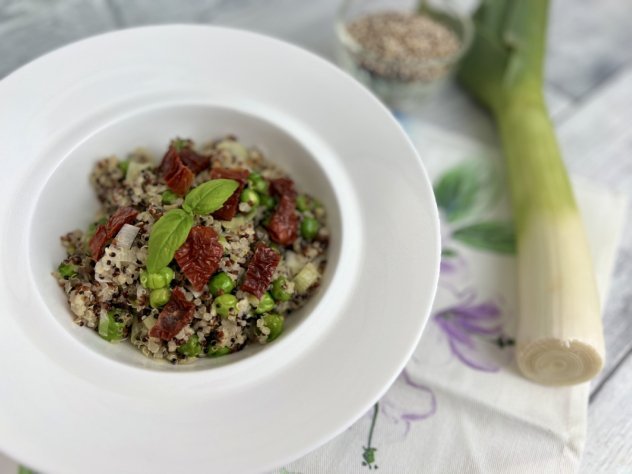
My Quinoa salad, on the other hand, is perfect for a refill of plant protein. Quinoa is a gluten-free pseudo-cereal that has all 8 essential amino acids (i.e. those that must be taken in with food as they are not produced by our body) and therefore has a very similar nutritional profile to foods of animal origin. Moreover, due to its wealth of other micronutrients, it is considered a super-food whose consumption is strongly recommended as an integral part of a healthy, balanced diet.

Remember to rinse quinoa before cooking to remove saponins, substances naturally present in many vegetables, which may cause irritation to mucous membranes, but are completely eliminated by a pre-cooking wash.

If you only have a few minutes available, see how to prepare Three five-minute salads!!

Cauliflower couscous with Radicchio variegato

carbohydrates 14g for the whole serving

cous-cous-di-cavolfiore-uvetta-e-fragole

Ingredients for 1 serving

  • 80g cauliflower
  • 40g radicchio variegato di Castelfranco
  • 15g raisins
  • 15g shelled walnuts
  • 1 teaspoon of toasted sunflower seeds
  • 1 teaspoon of pumpkin seeds
  • 1 strawberry
  • Traditional Balsamic Vinegar of Modena
  • extra virgin olive oil
  • salt and pepper

Preparation

  1. Grate the cauliflower with a coarse-hole grater to obtain a couscous-like consistency.
  2. Wash, dry and cut the Radicchio into pieces.
  3. Assemble the salad by placing the radicchio on the bottom of the plate and the cauliflower couscous on top; season with salt and pepper, oil and traditional balsamic vinegar of Modena, then complete by adding the raisins, nuts, seeds and finally the strawberry cut into thin slices.

Quinoa salad with leek and peas

carbohydrates 20.11g for the whole serving

insalata-di-quinoa-e-piselli

Ingredients for 1 serving

  • 25g quinoa (weighed raw)
  • 40g shelled fresh peas
  • 30g leek
  • 7g desalted capers
  • chopped basil and sage
  • sun-dried tomatoes*
  • extra virgin olive oil
  • salt and pepper

Preparation

  1. Rinse the quinoa under running water and cook it in 75g of lightly salted water for about 20 minutes or until it has absorbed all the water.
  2. Put a little oil in a non-stick frying pan and brown the finely sliced leek and peas in it, adding a few tablespoons of water to cook them. Add desalted capers and chopped basil and sage. When the peas are almost cooked, add the quinoa and season with salt (if necessary) and pepper.
  3. Serve the quinoa topped with a few chunks of sun-dried tomatoes and basil leaves.

insalata-di-quinoa-e-piselli

Cous-cous-di-cavolfiore-uvetta-e-fragole

Version with gluten of April salads

The recipes contain only naturally gluten-free ingredients, so no adaptation is necessary for their version with gluten.

Food is becoming more and more precious, which is why we need ideas to never waste it. Pappa al pomodoro is an extraordinary example of recovery in the kitchen to which I wanted to add an idea to prepare Parmigiano Reggiano rinds in a super tasty way: this is my Pappa al pomodoro with crispy rinds.

When you have some pieces of bread left at the table, do not throw them away, but keep them in a paper bag. When you have 300-400g of it, you will finally have enough to cook Pappa al pomodoro for the family as a single dish, although I must confess that sometimes I also use a portion of fresh bread in order to be able to enjoy this dish of Tuscan peasant cuisine!

During the summer months you can substitute tomato sauce (I used tomato sauce made from Buttiglieddru cherry tomatoes a Slow Food Presidium, known at the Terra Madre event in Turin) made from juicy ripe tomatoes, taking care to blanch them for a few minutes in boiling water to remove the peel easily.

Do you know another great characteristic of this recipe? It is delicious whether eaten hot in the winter months or cold during the summer.

And the Parmigiano Reggiano rinds? It’s amazing that 2 minutes in the microwave oven at maximum power can turn a hard, firm rind into a crispy cloud, very similar to the puffed snacks you find on supermarket shelves, but much healthier from a nutritional point of view! In short, an irresistible savoury snack that makes you feel less guilty!

Furthermore, without the addition of the crunchy rinds, Pappa al pomodoro is also suitable for those who follow a vegan diet.

Have I intrigued you? Then discover the recipe below.

pappa-al-pomodoro-con-croste-croccanti


Pappa al pomodoro with crispy rinds

15.62g carbohydrates per 100g

Ingredients for 4 servings (as a single-course meal)

  • 400g stale bread** (I used this Mixed leavening bread)
  • 800g tomato sauce or 1.1 kg ripe tomatoes (to be blanched and peeled)
  • 800g ca. vegetable stock*
  • 1 clove of garlic
  • basil
  • extra virgin olive oil
  • salt, pepper and chilli pepper (to taste)

Ingredients for the crispy rinds

  • Parmigiano Reggiano rinds about 0.5-1cm thick

**Ingredients specific for celiacs

*Ingredients whose labels must read “gluten-free” (or, in Italy, present on  Prontuario AIC)

Preparation

  1. Cut the bread into cubes and toast it in the oven.
  2. Put the bread in a large pan and cover it with the tomato sauce or peeled chopped tomatoes and the vegetable stock, garlic clove and a drizzle of oil. Put a lid on.
  3. When the bread starts to become creamy, add a few basil leaves, possibly more stock and stir occasionally. Season with salt, pepper and chilli pepper to taste.
  4. Cut the Parmigiano Reggiano rinds into 2cm squares and spread them out on a microwaveable plate, leaving them well apart. Set the microwave to 2 minutes at maximum power, then let the rinds cool down. They should be light and as crispy as clouds when eaten, so if they are still hard, microwave again for a very short time.
  5. Place the individual servings of Pappa al pomodoro on a plate, top with a drizzle of oil, a grinding of pepper and the crispy rinds, then serve immediately.

pappa-al-pomodor-con-croste-croccanti

Version with gluten of Pappa al pomodoro with crispy rinds

Replace the gluten-free bread with conventional bread, all other ingredients are naturally gluten-free, so no adaptations are necessary.

Are you looking for more ideas for your out-of-home lunch? Eating out is indispensable not only for those who work, but also for those who study, so the time has come to share some recipes for your lunch box or for what Japanese people call “bento“… Well, many ideas for lunch boxes that are complete, balanced and tasty to take with you on every occasion.

So, for our young ones going to university and having to eat gluten free and to count carbohydrates easily, the lunch box is a faithful travel mate that contributes to turning the lunch break into a joyful moment.

We found the perfect lunch box for our needs at our friend’s store “I love my house” whom I always ask for help when I am looking for equipment and kitchen solutions: here is where you can find our LUNCH BOX.

This is the beginning of a project that is very dear to me because lunch is a key meal, especially for out kids and we cannot allow ourselves to run short of ideas!

Stay tuned for many more fantastic recipes! Meanwhile, have a look at my Coronation pasta salad.

Pasta with chickpea cream and broccoli

85.91g carbohydrates for the whole lunch box

Ingredients for 1 lunch box

  • 110g broccoli florets
  • 100g boiled chickpeas
  • 70g Massimo Zero Organic Pipe**
  • 15g dried apricots
  • 1 tbsp of lemon juice
  • paprika
  • extra virgin olive oil
  • parsley
  • salt

**Ingredients specific for celiacs

*Ingredients whose labels must read “gluten-free” (in Italy they may be listed on  Prontuario AIC)

Preparation

  1. Boil pasta al dente in salted boiling water, drain and dress it with a dribble of extra virgin olive oil leaving the pasta to cool down.
  2. Blend 70g chickpeas with about 50g water, lemon juice, salt and pepper and a dribble of oil to obtain a cream.
  3. Dress the remaining chickpeas with paprika, pepper and oil to taste, together with blanched broccoli florets.
  4. Season the pasta with the chickpea and broccoli mixture, then add the dried apricots cut in pieces and pour everything in the lunch box.
  5. Put the chickpea cream in the second container or on the pasta completing with a dusting of chopped parsley and a dribble of oil.  Mix well before eating.

Version with gluten of Pasta with chickpea cream and broccoli 

The recipe contains only naturally gluten free ingredients, so no adaptation is necessary for its version with gluten; however, if you want, you can replace Massimo Zero corn and rice pasta with a durum wheat alternative.

We could write pages and pages of recipes with tomatoes, so let’s start with this one: my No-cook stuffed tomatoes, a vegetarian, tasty, fibre-rich preparation that does not require the oven.

The main trick to make good stuffed tomatoes is to drain them and let them lose their water by sprinkling them with a pinch of salt and laying them ‘upside down’ on a surface covered with kitchen paper. Furthermore, it is important to choose perfectly ripe and firm tomatoes to get the best out of this preparation.

And if you like fresh fillings for summer, try my Travel Caprese.

No-cook stuffed tomatoes

6.64g carbohydrates per 100g

Ingredients for 4 servings

  • 720g approx. tomatoes (4 ripe, firm salad tomatoes)
  • 170g yellow and red pepper
  • 50g peas
  • 40g onions
  • 30g breadcrumbs**
  • 30g pitted black olives*
  • 8g capers
  • extra virgin olive oil, salt and pepper to taste

**Ingredients specific for celiacs

*Ingredients whose labels must read “gluten-free” (or, in Italy, present on  Prontuario AIC)

Preparation

  1. Cut the tops off the tomatoes, empty them, add a pinch of salt, then place them on a tray covered with kitchen paper to drain the water they produce. Use the inside of tomatoes to add to a soup or sauce.
  2. Meanwhile prepare the filling. In a frying pan, sauté the sliced onion, then add the peas and diced pepper, and cook. Remove from the heat and add the breadcrumbs, capers, chopped olives and season with salt and pepper.
  3. Stuff the tomatoes with the vegetable mixture and serve.

Pomodori ripieni senza cottura

Version with gluten of No-cook stuffed tomatoes

Replace gluten free breadcrumbs with standard breadcrumbs; no other adaptation is needed.