Tag Archive for: ricette naturalmente senza glutine

September is the month when summer and autumn meet, just like the ingredients that characterise it: this is what you are going to discover in September Salads.

So what are the September salads? First of all, a tasty Chicken salad with radicchio and melon balls that is also perfect for your lunch box to take to the office as a balanced and light meal, or it can be a nice dinner to ensure a quiet night.

The second recipe is tasty and colourful, versatile and suitable for meals at home or away from home, the Salad of citrus flavoured cherry tomatoes with Venere rice introduces us to the quintessential winter fruit, i.e. oranges, which I have used here together with lemon to flavour the cherry tomatoes and make them really special.

So more colours to cheer us up into the less sunny days of September.

If you fancy some richer salads, check out the May and its fortified salads.

Chicken salad with radicchio and melon balls

carbohydrates 3.3g per 100g – 8.93g per serving
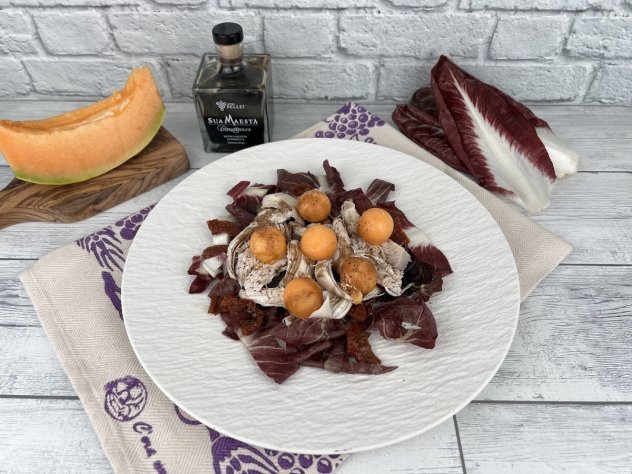
Insalata-di-pollo-al-radicchio-e-sfere-di-melone

Ingredients for 4 servings

  • 500g chicken breast
  • 280g melon
  • 180g red radicchio
  • 120g dried tomatoes in olive oil*
  • extra virgin olive oil
  • Aged Balsamic Vinegar of Modena
  • sage
  • bay leaf
  • 1 teaspoon green peppercorns
  • 3 cardamom berries
  • 1 star anise berry
  • salt and pepper

Preparation

  1. Put a pan of water on the stove with a few sage leaves, a bay leaf, cardamom, star anise, green pepper and salt, and boil the chicken breast in it for 20 minutes. Once cooked, leave the chicken to cool in its stock.
  2. Assemble your salad by cutting the radicchio into strips and placing it on the bottom of the plate. Flavour it with the dried cherry tomatoes cut into strips, thread the cooled chicken over it and complete with melon balls.
  3. Season with a pinch of salt and pepper and drizzle with a little extra virgin olive oil and balsamic vinegar.

Salad of citrus flavoured cherry tomatoes and Venere rice

carbohydrates 13.7g per 100g – 39.79g per serving

Insalata-di-pomodorini-agli-agrumi-e-riso-Venere

Ingredients for 4 servings

  • 600g mixed coloured cherry tomatoes
  • 140g Venere rice
  • 120g Greek feta cheese
  • 80g pitted green olives*
  • 80g pitted black olives*
  • 1/2 orange with edible peel
  • grated lemon peel
  • basil
  • extra virgin olive oil
  • salt and pepper

*Ingredients whose labels must read “gluten-free” (or, in Italy, present on  Prontuario AIC)

Preparation

  1. Boil the Venere rice in lightly salted water and drain when al dente.
  2. Cut the cherry tomatoes in halves or quarters, add the sliced olives and season for 15 minutes with orange slices and grated lemon peel.
  3. Put the Venere rice in the salad bowl, cover it with the cherry tomato and olive mixture after removing the orange slices. Season with a drizzle of oil and some freshly-ground pepper (no need for salt as the salad contains salty ingredients) and complete with crumbled feta cheese and a few basil leaves.
 

Beat the heat with these July salads that will feature some of the most beloved seasonal ingredients, peaches and tomatoes.

Furthermore, back from my holidays in Sardinia, I wanted to use a Slow Food Presidium that I had never tried before: the cheese called Frue or Casu axedu, meaning “sour cheese” in Sardinian dialect, made with sheep’s or goat’s milk leaving the curd in the whey. The resulting cheese is a product that is a combination of yogurt and cheese, it is without rind, soft and sour. It is sold in small cubes or larger pieces always covered with whey.

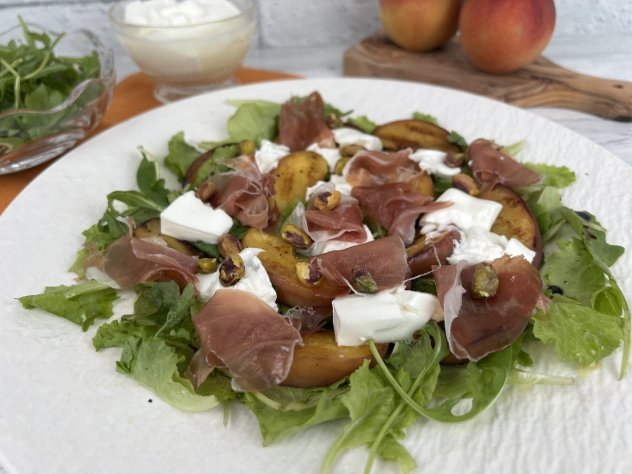
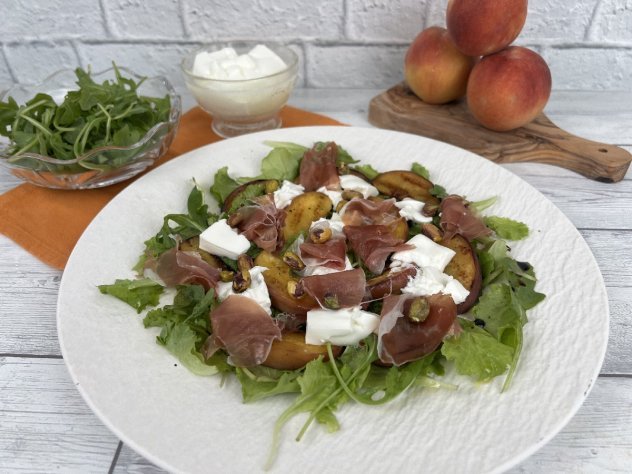
Because of its sour taste, Frue may be too strong for many people, so I decided to combine it with sweet grilled peaches and a savoury Prosciutto di Parma matured for 24 months: simply delicious!

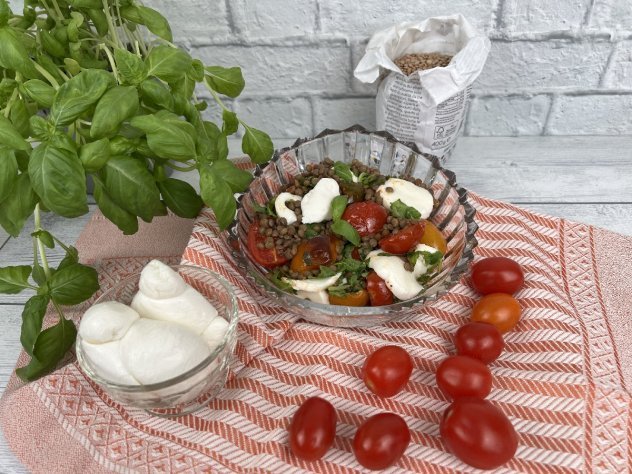
The second salad is a fun way of eating lentils also in summer making them fresh and colourful with cherry tomatoes, and the aroma of garden rocket and basil.

In addition to these July salads, for other fresh and easy-to-make ideas, have a loot at my June salads.

Salad of grilled peaches and Prosciutto

carbohydrates 6g for the whole serving

insalata-di-pesche-grigliate-e-prosciutto

Ingredients for 1 serving

  • 100g peaches with peel on
  • 80g Frue sour cheese or Mozzarella cherries
  • 40g Prosciutto di Parma (2 slices)
  • a handful of baby lettuce
  • a handful of garden rocket
  • 15g shelled pistachio nuts
  • spray extravirgin olive oil Fratelli Mantova
  • Balsamic vinegar of Modena
  • salt and pepper

Preparation

  1. Cut the peaches into thin segments and grill them without adding any grease or dressings.
  2. Form a layer of baby lettuce and garden rocket on the serving dish, then arrange the grilled peaches on top; dress with a pinch of salt, freshly ground pepper, a spray of extravirgin olive oil and a dribble of Balsamic vinegar.
  3. Complete with pieces of sour cheese or Mozzarella cherries, the slices of Prosciutto torn into smaller pieces and the pistachio nuts.

insalata-di-pesche-grigliate-e-prosciutto

Salad of lentils and sautéed cherry tomatoes

carbohydrates 37.41g for the whole serving

insalata-di-lenticchie-e-pomodori-arrostiti

Ingredients for 1 serving

  • 180g cherry tomatoes of various colours
  • 150g boiled lentils (about 50g dry lentils)
  • 70g Mozzarella cheese
  • garden rocket
  • basil
  • oregano
  • extravirgin olive oil
  • salt and pepper

Preparation

  1. Boil the lentils in water with carrot, celery, onion and garlic; drain and allow to cool down.
  2. Pour a dribble of extravirgin olive oil in a non-stick pan and sautéed the cherry tomatoes cut in half, intially with the cut side downwards. Adjust flavour with salt, pepper and oregano and cook for a couple of minutes.
  3. Dress the lentils with the sautéed tomatoes, adjust flavour with olive oil, salt and pepper if necessary, then finish with pieces of Mozzarella, strips of garden rocket and some basil leaves.

insalata-di-lenticchie-e-pomodori-arrostiti

As summer officially begins on 21st June, June salads will delight us with the addition of seasonal fruit.

Asparagus continues to be present, which we can enjoy with a mouth-watering cheese cream and plums for a salad that also becomes a green all-in-one dish, great to take to the office or to the pool in a convenient lunch box.

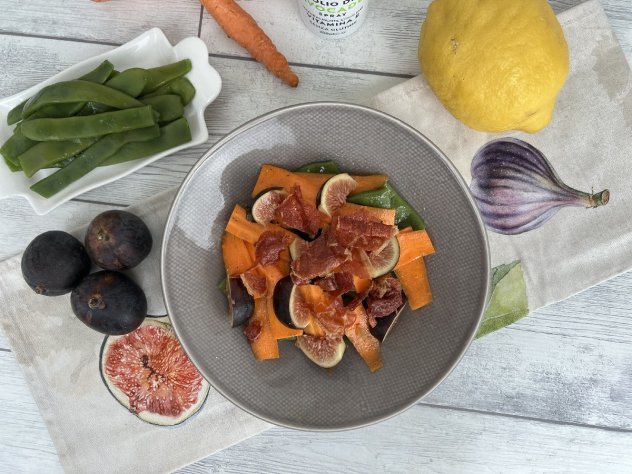
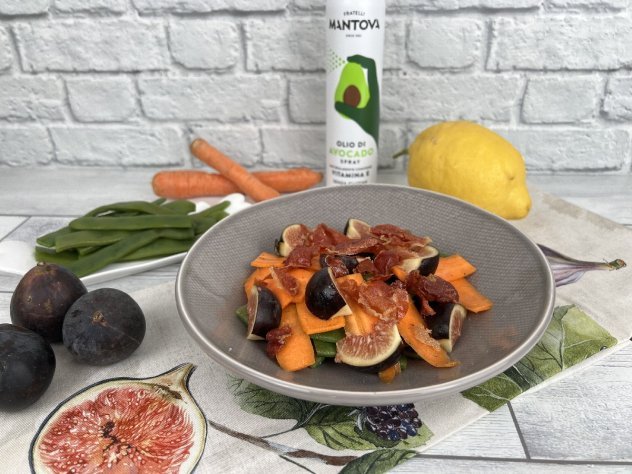
My salad with cooked vegetables features snow peas accompanied by carrots, but above all by the contrast of the sweetness of the figs and the saltiness of the crispy Prosciutto di Parma: as an appetiser, main course or as a one-course meal, the Salad of snow peas and figs will win you over with its explosion of flavours.

The tip I want to share with June salads is the use of spray oil, a very interesting way to dress our dishes. Why?

For two main reasons: the first is that we will use up to 90 per cent less oil for dressing, thus significantly reducing the calorie intake of the salads themselves; the second is that in the canned bag of Fratelli Mantova the oil is stored in the dark and protected from the air, thus guaranteeing ideal preservation.

My choice for these salads is avocado oil containing 100% oil extracted from the pulp of the avocado fruit, rich in vitamin E, with a light and delicate taste and texture.

For more ideas, see also the reinforced salads of May.

Asparagus and plum salad

carbohydrates 7.76g for 1 serving

insalata-di-asparagi-e-prugne

Ingredients for 1 salad

  • 3-4 asparagus
  • 50g plums
  • 30g soy milk*
  • 30g Ricotta cheese
  • 20g Robiola cheese
  • shelled pistachios
  • 1 lemon with edible zest
  • Fratelli Mantova’s avocado oil
  • salt and pepper

*Ingredients whose labels must read “gluten free” (or, in Italy, present on  Prontuario AIC)

Preparation

  1. With a mandoline, slice the asparagus into ribbons and marinate them for at least 15 minutes with a teaspoon of lemon juice, salt, pepper and a splash of avocado oil.
  2. Prepare a cream by mixing ricotta, robiola, grated lemon peel and a grinding of pepper.
  3. Assemble the salad by placing the asparagus ribbons in a salad bowl, the cheese cream, the plums cut into wedges and a sprinkling of shelled pistachios.

insalata-di-asparagi-e-prugne

Snow pea and fig salad

carbohydrates 9.58g for 1 serving

insalata-di-taccole-e-fichi

Ingredients for 1 serving

Preparation

  1. Slice the carrots into ribbons using a mandoline, season them with lemon juice, salt, pepper and a splash of avocado oil, then allow to rest for the time needed to prepare the other ingredients.
  2. Boil the snow peas in boiling salted water until cooked but still firm. Plunge them into cold water, then drain immediately.
  3. Place the Prosciutto slice on a plate and let it crisp up in the microwave or in a non-stick frying pan: in the microwave, set the oven on low power for short periods of time until the desired crispiness is reached; in the frying pan, do not grease the bottom and cook on low heat until crispy.
  4. Assemble the salad by placing the snow beans on the bottom of the salad bowl, the carrot ribbons and a well-washed fig cut into wedges, season with a pinch of salt, pepper and a splash of avocado oil, then finish by adding the crispy prosciutto slice.

insalata-di-taccole-e-fichi

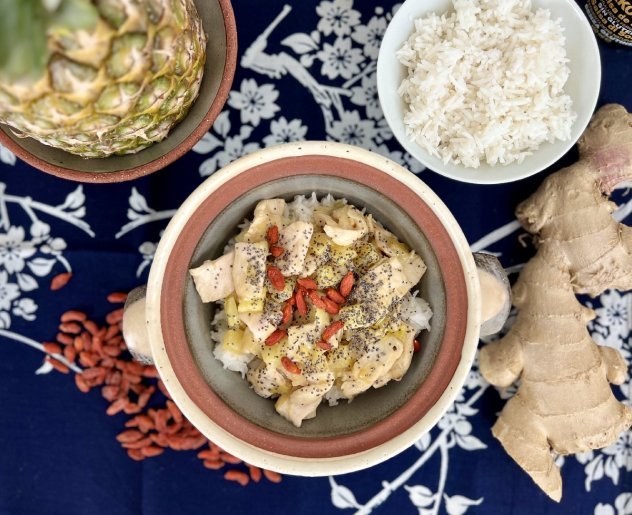
Poke is a traditional Hawaiian dish prepared with marinated raw fish accompanied by other ingredients making it a fresh, tasty and complete meal; my Pineapple chicken poke is my interpretation of a one-course meal that is equally tasty and complete, but made with meat as a source of protein.

In fact, who has difficulties in finding fresh chicken and pineapple? Normally nobody, therefore having a recipe that can answer the age-old question of what to cook for dinner is a great relief, also because this Poke will be ready in 10 minutes, practically the time Basmati rice takes to cook.

If you can, remember to soak the Basmati rice for 10 minutes before boiling it: its grains will be plump and long once cooked for an extra taste pleasure!

Try also Basmati rice with curry, tuna and peppers if you want a touch of Oriental cuisine on your table.

Pineapple chicken poke

22.28g carbohydrates per 100g

poke-di-pollo-allananas

Ingredients for 4 servings

  • 350g chicken breast sliced very thinly
  • 200g Basmati rice
  • 200g fresh pineapple
  • 100g green onions
  • 20g corn starch*
  • 1 piece of fresh ginger
  • gluten-free soy sauce*
  • Goji berries to taste
  • poppy seeds to taste

*Ingredients whose labels must read “gluten-free” (or, in Italy, present on  Prontuario AIC)

Preparation

  1. Soak the Basmati rice in water for 10 minutes before boiling it in 400g of water and a pinch of salt. Once cooked, set it aside.
  2. Coat the chichen slices with corn starch making sure you shake them well so that only a think layer of starch remains on the meat. Cut the chicken slices to strips.
  3. Cut a thick slice of pineapple, remove the peel and dice it.
  4. Cut the green onions into rounds and sweat them in a non-stick pan with a dribble of oil, ginger to taste chopped very thinly and some spoons of water. When the green onions are soft, add the chicken on high heat, stir and douse with soy sauce cooking for some minutes.
  5. Add the pineapple, half a glass of water to form a runny sauce and cook for some more minutes.
  6. Assemble your poke: put the basmati rice in a soup dish or bowl, top it with the pineapple chicken and finish with Goji berries and poppy seeds to taste.

poke-di-pollo-allananas

Version with gluten of Pineapple chicken poke

The recipe contains only naturally gluten-free ingredients, so no adaptation is necessary for its version with gluten.


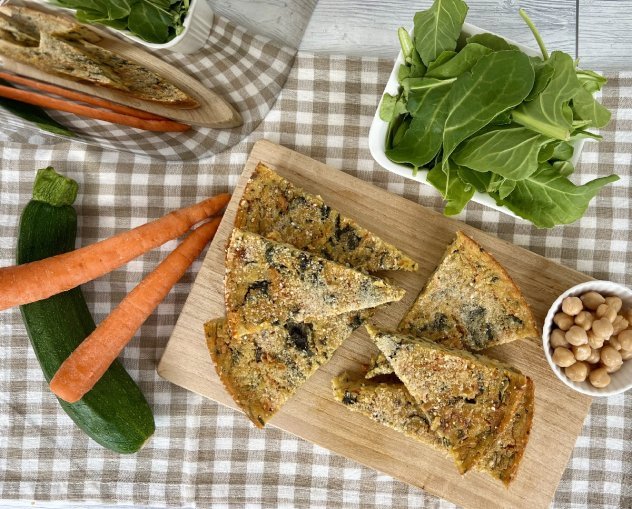
A chickpea flour flan with lots of vegetables, also perfect for using the leftover vegetables in the fridge: try the Chickpea and Vegetable Flan.

I love this recipe that a friend taught me because it not only allows me to have a one-course meal that is perfect for diabetes and coeliac disease, but also because I can prepare it using just one pot! Thanks to the Berndes pot I found at my friend Michela’s store, I Love My House, you can in fact cook the vegetables on the stove first, then complete the recipe by putting the pot in the oven.

The vegetables I used are just an indication, but you can use your favourite vegetables or any vegetables that you may have in small quantities: a tasty and easy anti-waste recipe.

Furthermore, the leftover flan is a perfect lunch box to take to the office or to school.

If you’re running out of ideas for lunch boxes, here are some ideas.

Chickpea and vegetable flan

carbohydrates 11g per 100g

sformato-di-ceci-e-verdure

Ingredients for a 28cm flan

  • 600g water
  • 200g chickpea flour*
  • 150g Tropea onions
  • 150g courgettes
  • 150g carrots
  • 80g Swiss chard
  • 30g Parmigiano Reggiano cheese
  • extra virgin olive oil
  • salt and pepper

*Ingredients whose labels must read “gluten-free” (or, in Italy, present on  Prontuario AIC)

Preparation

  1. Put the chickpea flour in a bowl and pour the water over it in a trickle stirring with a whisk so that no lumps form. Let the batter rest for at least 3 hours.
  2. Slice the Tropea onions and brown them in a non-stick pan suitable for use in the oven too; add the julienne-cut carrots and courgettes, then a few tablespoons of water to prevent the vegetables from frying. Stir well, cook for a few minutes, then add the herbs. Season with salt and pepper and remove from the heat when the Swiss chard has wilted.
  3. Add a pinch of salt and a drizzle of oil to the chickpea batter, then pour it into the pan containing the vegetables and bake in a convection oven preheated to 160°C for 25 minutes.
  4. Open the oven, sprinkle the surface with grated Parmesan cheese and a drizzle of oil, then put back in the oven for another 5 minutes.
  5. Serve the flan warm cut into slices.

sformato-di-ceci-e-verdure

Version with gluten of Chickpea and vegetable flan

The recipe contains only naturally gluten free ingredients, so no adaptation is necessary for its version with gluten.

Would you like some ideas for out-of-home meals that come directly from the traditions of southern Italy? Here is how to prepare Broad bean puree with vegetables, a very simple dish, but absolutely extraordinary in terms of taste and well-being.

Once prepared, put a serving in the lunch box (I prepared a larger amount to use for the whole family), complete with boiled or baked seasonal vegetables and lunch is served!

Broad bean puree is prepared from dried broad beans, so you can cook it in any season, while the accompanying vegetables will change: have fun changing vegetables! At this time of year, rapini are the stars, so they couldn’t be missing alongside this soft, smooth puree.

Mashed broad beans are certainly more interesting than their more famous potato-based dish as they are rich in plant protein and slow-absorbing complex carbohydrates. Moreover, by accompanying it with vegetables, we will have a high percentage of fibre, our great ally of well-being.

Follow me not to run out of ideas for out-of-home meals and have a look at Legumotti with vegetable ragout and Jerusalem artichokes.

Broad bean puree with vegetables

32.16g carbohydrates for the whole lunch box

Ingredients for 1 lunch box

  • 60g dried broad beans
  • water
  • rapini and other boiled or baked vegetables to taste
  • extra virgin olive oil
  • 2 bay leaves
  • salt and pepper

**Ingredients specific for celiacs

*Ingredients whose labels must read “gluten-free” (or, in Italy, present on  Prontuario AIC)

Preparation

  1. Rinse the broad beans and soak them in water the night before.
  2. Transfer the broad beans to a pan (use the soaking water for kneading the bread!) and cover them with water in such a way to have about 3cm of water above their surface. Simmer for about 1 hour or until the broad beans have dissolved.
  3. Pour the broad beans into a blender and blend them while pouring in extra virgin olive oil in a drizzle to make the puree nice and creamy, then add salt and pepper to taste.
  4. Assemble the lunch box with mashed broad beans accompanied by blanched rapini and other vegetables to taste: I added onion and baked beetroot.

Purè di fave con verdure

Ideas for out-of-home meals are always good because we increasingly eat lunch away from our kitchens. What does our lunch box contain today? An appetising Red rice salad with avocado cream.

Red rice is a wholemeal alternative to white rice, thus an excellent substitute, rich in flavour and, above all, fibre. In this lunch box you will find it paired with a tasty cream of avocado, a fruit rich in antioxidants and cholesterol-friendly mono-unsaturated fatty acids, and a vegetable salad enriched with the Omega 3 of tuna.

Here then is how you can prepare it for another good and satisfying lunch.

Follow me not to run short of ideas for out-of-home meals! And if you are looking for meals with a lower amount of carbs, try my Roastbeef with aubergine cream.

Red rice salad with avocado cream

51.72g carbohydrates for the whole lunch box

Ingredients for 1 lunch box

  • 60g Basmati rice
  • 1/2 avocado
  • 40g drained tuna
  • 40g iceberg lettuce
  • 30g fat free Greek yoghurt
  • 30g carrots
  • 30g pitted green olives
  • lemon juice
  • parsley
  • extra virgin olive oil
  • salt and pepper

**Ingredients specific for celiacs

*Ingredients whose labels must read “gluten-free” (or, in Italy, present on  Prontuario AIC)

Preparation

  1. Boil the red rice in lightly salted water, possibly making sure that the rice completely absorbs the liquid. Season with salt and pepper and drizzle with a little oil.
  2. Mash half an avocado in a bowl and add Greek yoghurt, season with parsley, salt and pepper.
  3. Prepare the salad by cutting iceberg lettuce into strips, grate the carrots, add the pitted olives and dress with extra virgin olive oil, salt and pepper.
  4. Fill the lunch box by placing the red rice in one of the containers with the drained tuna and the avocado cream, while placing the vegetable salad in the second container. Close it up and take it with you!

riso rosso con crema di avocado

Sometimes it is just an idea that gives a standard dish an extra touch, so a rice salad can turn into a colourful lunch to deal with the summer heat: here is a perfect summer recipe, my Venere rice salad in a glass.

The rule I am following these days with no air conditioning in my kitchen is just one: no oven, unless I have to bake bread. So, here is a one-course meal ready in 30 minutes, unless the cooking time for your rice takes longer.

Furthermore, if you like this summer recipe idea, use your creativity to invent many other rice salads layering them in a glass to make your table unique and fun for your table companions.  Have a look at these Venere rice towers  to find inspiration!

Summer recipe: Venere rice salad in a glass

9.5g carbohydrates per 100g

Ingredients for the courgettes cream

  • 300g courgettes
  • 170g water or vegetable stock*
  • 100g leek
  • 20g extra virgin olive oil
  • a bunch of basil
  • some mint leaves
  • salt and pepper

Ingredients for the mozzarella mousse

  • 400g cow’s milk mozzarella
  • 20g extra virgin olive oil
  • water

Ingredients for assembling 4 glasses

  • 200g cherry tomatoes
  • 100g Venere rice
  • basil leaves
  • extra virgin olive oil
  • salt and pepper

*Ingredients whose labels must read “gluten-free” (or, in Italy, present on  Prontuario AIC)

Preparation

  1. Cook the Venere rice in lightly salted water and drain it when it has the perfect texture to be eaten, then lay it out to cool quite quickly.
  2. In the meantime, chop the leek and sweat it in a pan with the extra virgin olive oil, add the chopped courgettes, allow them to gain flavour for a minute, then add the water, basil and mint and cook for 12-13 minutes.
  3. Pour everything in a blender, blend to a smooth cream and season with salt and pepper. Put aside.
  4. Place the chopped mozzarella in a large, tall glass, add 4-5 tablespoons of water and start blending with an immersion blender (ideal for the texture is to use a Bamix) while also pouring in the extra virgin olive oil in a trickle. If the mozzarella cream is too hard, add a few more tablespoons of water while continuing to blend until it is soft and creamy like a mousse. Season with salt and pepper.
  5. Cut the cherry tomatoes into 4 wedges, season with salt and pepper and a drizzle of extra virgin olive oil.
  6. Now assemble the glasses: pour the courgette cream on the bottom, form a layer of Venere rice, a layer of mozzarella mousse, the chopped cherry tomatoes and finally decorate with a few basil leaves.

insalata di riso venere in bicchiere

Version with gluten of the summer recipe: Venere rice salad in a glass

This recipe contains only naturally gluten-free ingredients, so no adaptations are necessary.


Have you already thought about what to prepare for Easter lunch? Do you have any family recipes that you prepare on this occasion? For Easter lunch at our house, the first course is the ever-present Anolini in meat stock, but we are always on the lookout for a new meat main course that everyone will agree on. So here’s an extra idea that you can cook with me as we watch the video recipe: White meat loaf.

This white meat loaf is very simple and can also be prepared the night before, then cooked at the last minute. The presence of hard-boiled eggs (symbol of new life) makes it nutritionally rich and beautiful to serve on the table with its lively colours.

If you are still looking for ideas for the Easter lunch menu, this meat main course could be a nice solution: naturally gluten-free and without carbohydrates. Happy Easter!

White meat loaf

negligible carbohydrates per 100g

Ingredients

  • 600g ground turkey and chicken meat
  • 250g fresh or frozen spinach
  • 90g Speck slices*
  • 50g Parmigiano Reggiano cheese, grated
  • 4 eggs
  • Pecorino cheese, grated
  • extra virgin olive oil
  • salt
  • pepper

**Ingredients specific for celiacs

*Ingredients whose labels must read “gluten-free” (or, in Italy, present on  Prontuario AIC)

Preparation

  1. Cook the fresh or frozen spinach in a non-stick pan with a little oil; season with salt and leave to cool.
  2. Hard-boil 3 eggs by placing them in boiling water. Let boil for 8 minutes. Once cooked and cooled, shell them.
  3. Place the ground meat in a bowl, add a pinch of salt, grated Parmesan cheese and 1 egg. Mix to obtain a homogeneous mixture.
  4. Roll out a sheet of baking paper, grease it with a little oil and lay the minced meat on it; with the help of a sheet of cling film and a rolling pin, form a rectangle of about 35x25cm.
  5. Form a layer of bacon on top, cover with spinach, season with grated Pecorino cheese, then place the 3 hard-boiled eggs in the centre of the rectangle. Roll it up into a cylinder and seal it tightly at the ends. Wrap the cylinder in the baking paper.
  6. Heat the convection oven to 200°C and bake the meatloaf for 25 minutes, then remove it and brown it quickly in a non-stick frying pan with a little oil. Cut into slices and serve.

Polpettone di carni bianche

White Meatloaf ready to taste

Version with gluten of White meat loaf

This recipe contains only naturally gluten-free ingredients, so no adaptations are necessary.

While still loving the ‘old’ way of travelling, I decided to embark on a journey of discovery of the Provolone Valpadana PDO through the project “Choose your taste, sweet or spicy, only from Europe”in collaboration with the European Commission and theItalian Food Bloggers Association. The project aims to improve the manner in which European quality labelled products are recognised and promote their consumption, and I did it with my Savoury muffins with Provolone Valpadana PDO.

logo progetto 

My encounter with this product dates back to my childhood when I accompanied my father to the International Dairy Cattle Fair in Cremona , where the food stands present at the social event for breeders from Northern Italy displayed huge cheese wheels, shiny, sometimes round and sometimes cylindrical. Their size fascinated and, at the same time, frightened me.

After so many years, discovering how this cheese is made fills my heart with joy.

The sweet and spicy Provolone Valpadana PDO

Where does the name of this cheese come from? From the Italian word prova “try” (because in the past, when there were no technological means to verify that the curd was fermented to the right point to be spun, pieces of it were taken and spinning tests were made repeatedly (hence the name Provola and its augmentative Provolone) until the results were perfect to proceed.

marchio

The production area of Provolone Valpadana PDO includes part of Lombardy, part of Veneto, the province of Piacenza and part of the province of Trento, an area characterised by the presence of the Po Valley.

The production process in brief

  1. Milk preparation in the boiler within 60 hours after milking.
  2. Addition of fermented whey from the end of the previous day’s processing and, if necessary, of additional lactic acid bacteria always obtained from the whey of Provolone Valpadana PDO.
  3. Rennet and curdling, the stage from which the differentiation between mild and piquant Provolone starts, thanks to the addition of calf rennet in the former and kid rennet in the latter, which cause the milk to curdle at a temperature of between 36 and 39°C.
    coagulazione

    Curdling (photo by Consorzio del Provolone Valpadana PDO)

  4. Fermentation and cutting of the curd, when the curd is allowed to rest by fermenting on suitable surfaces and, once ready, cut and then stretched.
  5. Stretching, a process that takes place in water at 85-95°C, consists of melting the curd by pulling it to form long threads.
  6. Moulding, cooling and firming, when the curd is moulded either by hand or in special moulds and placed in ice-cold water to promote rapid cooling and subsequent firming.
  7. Salting, which consists of immersing the cheeses in brine for a period of time depending on their size.
    salatura

    Salting (photo by Consorzio Provolone Valpadana PDO)

  8. Tying, possibly smoking and maturing are the final stages of production since once the cheeses are tied, they can be smoked and matured or stored for a short time in the case of sweet Provolone Valpadana PDO.
stagionatura

Maturation (photo by Consorzio Provolone Valpadana PDO)

Many shapes for many flavours

As a great cheese enthusiast, I find the variety of shapes in which Provolone Valpadana PDO can be presented really unusual, because each size will have its own uniqueness in terms of flavour. So not only is there a difference between sweet and piquant, but within those, ranging from small 6kg wheels to huge 100kg cheeses, the sensory profile develops in a multiplicity of nuances.

For this reason, maturation periods can vary from a minimum of 10 days to over 240 days!

How to use Provolone Valpadana PDO

Given the variety of flavours, textures and maturations, Provolone Valpadana PDO can be used in an infinite number of recipes, which will then be characterised by our choices: a delicate version with a milky scent or a strong touch of flavour and spiciness, as if we had added a pinch of chilli pepper.

Provolone can be used directly raw or in preparations that are to be cooked in a pan or in the oven. Here is the recipe I have prepared to share with you and which I cooked using mild Provolone Valpadana PDO, but which you can easily modify using the piquant version of the same cheese to obtain a completely different result: have fun experimenting!

Savoury muffins with Provolone Valpadana PDO

33.43g carbohydrates per 100 g

Ingredients for 4 large muffins

  • 90g wholemeal rice flour*
  • 75g Provolone Valpadana PDO sweet or spicy (sweet in the photo)
  • 2 eggs
  • 35g tapioca starch*
  • 30g milk
  • 25 g extra virgin olive oil
  • 20g dried tomatoes
  • 5g baking powder for savoury pies*
  • salt and pepper

*Ingredients whose labels must read “gluten-free” (or, in Italy, present on  Prontuario AIC)

Preparation

  1. Coarsely chop the Provolone cheese and dried cherry tomatoes and set them aside.
  2. Place the rice flour and tapioca starch in a planetary mixer or bowl, then mix with eggs, milk and oil until smooth and creamy; finally add the yeast, Provolone cheese and cherry tomatoes and season with salt and pepper.
  3. Pour the mixture into 4 rather large muffin tins, filling them 3/4 full.
  4. Bake the muffins in a static oven preheated to 180°C for 10-20 minutes.
  5. Take the muffins out of the oven and eat them warm – they are mouth-watering!

muffin salati al provolone

Version with gluten of Savoury muffins with Provolone Valpadana DOP

The recipe contains only naturally gluten free ingredients, so no adaptation is necessary for its version with gluten.