Tag Archive for: gluten free pasta

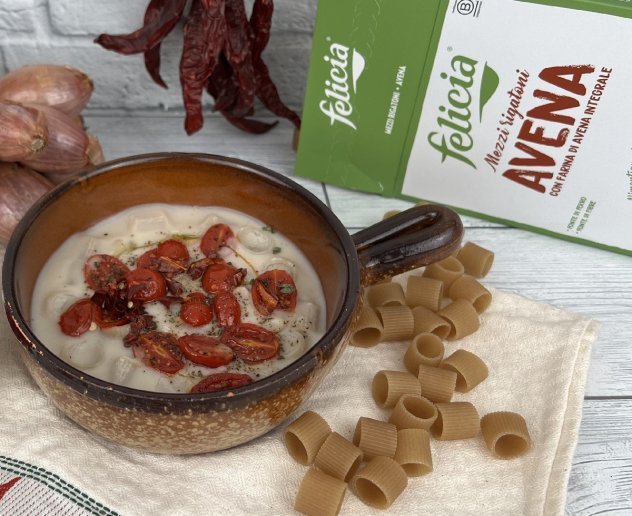
Can you think of those simple flavours that spark memories?  Oat pasta with cannellini beans is the perfect combination of traditional flavours and a touch of novelty.

One of the most typical dishes of Italian cuisine is in fact Pasta e fagioli (pasta and beans), a recipe often prepared with Borlotti beans and the addition of lard or bacon, which in the past were useful to give the necessary energy to face the hard work in the fields.

Instead, this version of Pasta e fagioli uses cannellini beans combined with oat pasta, where the wheat protein, gluten, is replaced by the high protein content in oat. Remember that beans are a valuable source of complex carbohydrates, plant proteins, fibre and are cholesterol-free, so the consumption of legumes is always a valuable ally in a balanced diet.

The flavour variation is the presence of sautéed cherry tomatoes with aromatic herbs that transform a classic taste into a fresher, juicier one.

If you love beans and tradition, try my Pisarei e fasò.

Oat pasta with cannellini beans

carbohydrates 13.63g per 100g

Mezzi-rigatoni-di-avena-ai-cannellini

Ingredients for 4 servings

  • 500g boiled cannellini beans (about 180g dry beans)
  • 240g cherry tomatoes
  • 140 g Oat pasta Felicia**
  • 1 shallots
  • 2 cloves of garlic
  • extra virgin olive oil
  • dried sweet pepper or Crusco pepper
  • bay leaf
  • oregano
  • thyme
  • rosemary
  • chilli pepper
  • salt and pepper

**Ingredients specific for celiacs

*Ingredients whose labels must read “gluten free” (or, in Italy, present on  Prontuario AIC)

Preparation

  1. Soak the cannellini beans for at least 12 hours, then boil them slowly in plenty of water with the addition of a bay leaf and, if available, a piece of Kombu seaweed to facilitate the beans’ future digestibility. Drain the beans and keep the cooking water.
  2. Cut the cherry tomatoes in half and sautée them for a few minutes on high heat in a non-stick pan with a little extra virgin olive oil, a clove of garlic cut in half, a chilli pepper and chopped herbs.
  3. Put a drizzle of extra virgin olive oil in a pan, brown a finely chopped shallot and a clove of garlic and add the cooked cannellini beans, cover with plenty of cooking water or vegetable stock and leave them to take on flavour for 10 minutes.
  4. Keep a few tablespoons of cannellini beans aside and blend the rest with an immersion blender, then reassemble the bean soup.
  5. Cook the oat pasta in plenty of salted water, drain and pour it into the cannellini soup, then complete the dish: place the pasta and beans on individual plates, complete with the herb flavoured tomatoes, a grinding of pepper, a drizzle of oil and some chopped dried sweet pepper or Crusco pepper.

Version with gluten of Oat pasta with cannellini beans

The recipe contains only naturally gluten-free ingredients.

Pasta salads are one of the most popular dishes in summer and every year I like inventing new ones to make a tasty and balanced dish suitable for all occasions.

The protagonists are the Strozzapreti Zero+, organic pasta made with 100% red lentil flour and eggs from free-range hens by the Spinosi pasta factory, a pasta designed to reduce the glycemic index of Italy’s most popular dish while providing a high protein and fibre intake: discover the entire range of gluten-free egg pasta with legume flours to have fun in the kitchen.

This pasta salad proposal is meant to take us tastefully to Greece, using the same ingredients we find in traditional Greek salads, but combined in a slightly different way.

Thanks to the presence of egg in Strozzapreti, the pasta salad has a perfect texture even when cold, which is very unusual in the world of gluten-free pasta, especially with a legume base, so you can enjoy an exquisitely fresh dish that is both healthy and balanced.

If you are looking for more pasta salad ideas, try my Coronation Pasta Salad.

Greek-style Strozzapreti pasta

10.8 g carbohydrates per 100g

Ingredients for 4 servings

  • 250g Strozzapreti Zero+ with red lentil flour*
  • 200g fat free Greek yoghurt
  • 200g cherry tomatoes
  • 100g Greek pitted black olives*
  • 100g Greek feta cheese
  • 70g pickled cucumbers*
  • extra virgin olive oil
  • mint
  • salt and pepper

Preparation

  1. Boil Strozzapreti in lightly salted boiling water for 7 minutes. Drain them, mix them with a drizzle of extra virgin olive oil and leave them to cool.
  2. Cut the cherry tomatoes into 4 wedges and add them to the Strozzapreti together with the black olives, then crumble the feta cheese and mix well.
  3. Prepare a sauce mixing Greek yoghurt with finely chopped pickled cucumbers, season with salt and pepper and pour it over the cold pasta. Complete by adding a few mint leaves and serve.

strozzapreti-alla-greca

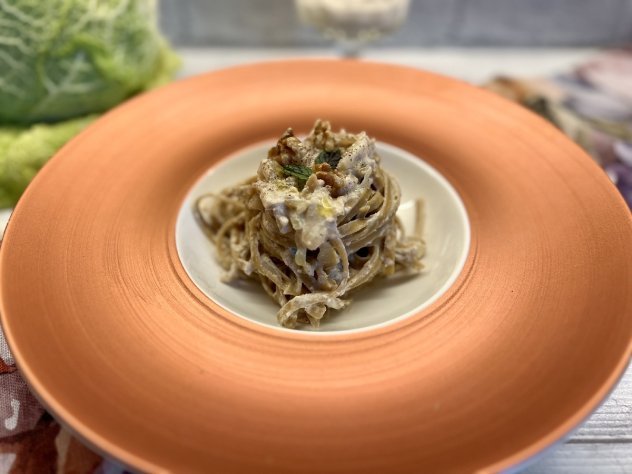
On Christmas Eve we have the tradition of preparing a long-shaped pasta dressed with tomato or walnut sauce, so this year I have decided to share an idea to cook Fettuccine with walnut sauce and cabbage using an artisan pasta made with legume flour and eggs by the pasta maker Spinosi in the Marche region.

Why a legume pasta? Certainly to reduce the carbohydrate amount of the pasta dish during a dinner made up of many courses, but also to increase the sense of satiety and thus reduce the craving for Christmas sweets at the end of the meal.

A characteristic that struck me in Fettuccine Zero+ Spinosi is the rough surface of the pasta, which is something very unusual in the world of gluten-free products. Furthermore, this pasta is an excellent ally in the diet of sports people thanks to its high (plant and animal) protein content.

Have I managed to relieve guilty feelings that are unavoidable during the holiday season? Then, let’s start cooking! and if you are looking for another pasta recipe, have a look at Paccheri filled with artichoke cream.

Fettuccine with walnut sauce and cabbage

15.35g carbohydrates per 100g

Ingredients for 4 servings

  • 300g cabbage or Savoy cabbage
  • 250g Fettuccine Zero+ Spinosi**
  • 1 clove of garlic
  • extra virgin olive oil
  • some walnut kernels
  • some mint leaves

Ingredients for the walnut sauce

  • 100g milk
  • 80g walnut kernels
  • 20g breadcrumbs**
  • a bit of garlic
  • salt and pepper

**Ingredients specific for celiacs

*Ingredients whose labels must read “gluten-free” (or, in Italy, present on  Prontuario AIC)

Preparation

  1. Sauté the cabbage or Savoy cabbage cut in thin strips in a large non-stick pan with a dribble of extra virgin olive oil and a clove of garlic adding some tablespoons of water to complete cooking; set aside.
  2. Prepare the walnut sauce. Soak the breadcrumbs in milk and, once soft, put in a blender with the remaining sauce ingredients. Blend to a smooth and even mixture.
  3. Put a pot of water on the heat, bring to the boil and salt it. Throw Fettuccine and cook al dente; drain and pour the pasta in the pan with the cooked cabbage, then mix adding the walnut sauce and some of the cooking water of Fettuccine.
  4. When Fettuccine are nice and creamy, serve and complete with some walnut kernels, freshly ground pepper, a dribble of extra virgin olive oil and some mint leaves.

fettuccine alla salsa di noci e verza

Version with gluten of Fettuccine with walnut sauce and cabbage

The recipe does not need adaptation for the version with gluten.

In Roman dialect, the term Fregnaccia means nonsense, lie, and nuisance, but in the tradition of Central Italy it also indicates a type of pasta, similar to a large, thick Maltagliato, so called to indicate the simplicity of a dish that wins you over with the flavour of its few, delicious ingredients. Here is the recipe for the second meeting with the Rieti-Viterbo Chamber of Commerce, Fregnacce alla sabinese.

And what are these extraordinary ingredients?

The Ovalone Rietino Tomato P.A.T. (i.e. traditional Italian agri-food product) of the Tenuta San Giovanni Farm of Gianfranco Gianni.

The Azienda Olearia’s Leccino Olives Bonifazi Oil

Petrucci’s Extra Virgin Olive Oil  and the lively The Three Doors Sabino chilli pepper

In preparing the recipe from the book ‘La Cucina Sabina’ by Maria Giuseppina Truini Palomba, we were guided by chef Marco Bartolomei and the result was a feast for the whole family.

Enjoy the journey and bon appétit!

Fregnacce Sabina style

49.3 carbohydrates per 100g of unseasoned Fregnacce


Ingredients for Fregnacce

  • 300g fresh pasta flour mix Molino Dallagiovanna** (for gluten-free version, see below)
  • 180g water (or however much you need to have a consistent dough)
  • a pinch of salt

Ingredients for sauce

  • 500g peeled Ovalone tomato
  • 100g Leccino olives in brine
  • 1 clove of garlic
  • parsley, chilli pepper, salt and extra virgin olive oil

**Ingredients specific for celiacs

*Ingredients whose labels must read “gluten-free” (or, in Italy, present on  Prontuario AIC)

Preparation

  1. Knead the flour with a pinch of salt and enough water to obtain a firm, homogeneous dough. Fate riposare la pasta in un sacchetto di plastica per circa 15 minuti.
  2. Divide the dough in half and roll it out with a rolling pin to a not-too-thin thickness, forming a large disc that you will leave to air dry for about half an hour. Roll each disc to form a large cylinder and cut it with the knife blade at an angle with the tip pointing once to the right and once to the left so that the resulting pieces are diamond- shaped.
  3. Prepare the sauce by putting the clove of garlic in oil with the chilli pepper. Brown the garlic well, then add the tomato after having mashed it well with a fork to make it homogeneous. Cook the sauce for about twenty minutes, seasoning with salt, then add the olives and chopped parsley and leave to season for another 10 minutes.

le fregnacce

  1. Boil the pasta in boiling salted water and when it rises to the surface, drain it, toss it in the pan with the sauce and leave it to season for a few minutes.
  2. Serve your pasta immediately because the saying in Romanesco goes ‘Cook the Fregnacce and eat them right away’.
Le fregnacce alla sabinese pronte per essere gustate

Fregnacce Sabina style ready to be thoroughly enjoyed

Version with gluten of Fregnacce Sabina style

Replace the Molino Dallagiovanna fresh pasta flour mix with an equal amount of wheat flour, adjusting the amount of water needed for kneading.

Preparing the Stracotto stew for Christmas Cappelletti is a big responsibility because expectations for the most anticipated meal of the year are always very high. This is how I prepared it to bring my whole family to the table… definitely feeling everyone’s eyes on me!

First of all, the stew should be prepared with three types of meat: beef, veal and pork. It’s a bit like doing no wrong to any of these meats, which at different times of the year brighten up our tables with extraordinary dishes.

As the name stracotto implies, the meat is cooked for such a long time that it falls apart simply by piercing it with a fork.

Once ready, the stew is blended or finely minced and the boiling cooking juices are used to wet the breadcrumbs that will be used to prepare the legendary Christmas Cappelletti, the meat-filled version of Anolini in broth.

And believe me, the type of filling is by no means an irrelevant matter! The tradition of eating one type of stuffing instead of the other is so ingrained that restaurants are obliged to put one or the other version on the menu according to boundaries dictated by custom, or else the menu would flop completely!

Here then is how to prepare Stracotto for fans and supporters of the meat version of this stuffed pasta, namely Cappelletti.

Stracotto for Christmas Cappelletti

negligible carbohydrates per 100g

Ingredients

  • 350g beef
  • 350g pork
  • 300g veal
  • 300g red wine
  • 50g onions
  • 50g carrots
  • 30g celery
  • 30g tomato paste
  • 30 g butter
  • 1/3 clove of garlic
  • 3 cloves
  • extra virgin olive oil
  • water
  • salt

Preparation

  1. Put the butter in a pan or earthenware casserole and melt it; add chopped onion, carrot and celery and brown it.
  2. Add the tomato paste and a third of a clove of chopped garlic, let the paste caramelise slightly, then place the three types of meat in the vegetable base, sealing the meat on all sides. Stick a clove into each piece of meat.
  3. Add the wine and pour in enough water to cover the meat, season with a pinch of salt, put the lid on and leave to cook on a low heat for at least 4 hours.
  4. After the time has elapsed, remove the cloves and add salt to taste. Remove the meat and put it in a food processor. Strain the cooking juices through a colander, add the remaining vegetable pieces in the colander to the meat in the processor and chop finely.
  5. Heat the liquid from the stew well and use it to scald the breadcrumbs of the Cappelleti filling.

stracotto

Version with gluten of Stracotto for Christmas Cappelletti

The recipe contains only naturally gluten free ingredients, so no adaptation is necessary for its version with gluten.

Do we really know where this dish comes from and how to prepare a Perfect Amatriciana?

Pronta a cucinare online dalla mia cucina

Ready to cook online from my kitchen

Discovering Amatriciana

Although the fame of Amatriciana sauce is linked to the city of Rome, its true cradle lies in the heart of our country. If you were to take a compass and place it in the centre of Italy, its point would probably end in Rieti, the easternmost city in Lazio between Umbria and Abruzzo, which gathers gastronomic traditions and extraordinary products from all these regions, and in whose province the city of Amatrice is located.

And it is from Rieti that the virtual journey in which I participated together with other bloggers, journalists and cooking enthusiasts began. Since we could not physically go there due to Covid restrictions, the Rieti Chamber of Commerce thought of making the products travel and sent us the kits containing the ingredients to prepare some traditional local recipes, more or less well-known outside their province of origin.

For our journey, from every region of Italy we went online armed with equipment, ingredients and a lot of curiosity. As good and diligent students, we listened to find out where the products we had received came from and how we should use them in our recipes, guided step by step by a local chef.

The perfect Amatriciana

First gastronomic encounter of the trip: Gricia and Amatriciana. Having to choose which of the two recipes to cook live, at my place they overwhelmingly opted for Amatriciana… and we didn’t regret it! This is how I find out that Amatriciana is a Traditional Speciality Guaranteed regulated by Specifications where, I must admit, some ingredients are a surprise. In fact, in addition to the ever-present guanciale (mind you, not pancetta!), extra virgin olive oil and  tomato sauce or peeled tomatoes, there are also white wine and chilli pepper. Naturally, the recommended ingredient is Pecorino cheese of the Amatriciano or Pecorino Romano DOP type.

Io, pronta per la diretta per cucinare gli spaghetti all'Amatriciana

Waiting to cook spaghetti all’Amatriciana live

Ingredients

Each of these ingredients tells a story. The matured pork cheek, Guanciale, tells us of the shepherds who were forced away from home for 4-5 months, usually from May to September, for the transhumance. For their sustenance, they carried some easy to store and nutritious products, such as Guanciale and flour. In an iron frying pan with a long handle, shepherds could thus cook their frugal, hearty main course: Pastasciutta (i.e. pasta), where pecorino cheese was the ingredient always available in the cool mountain pastures.

And the tomato? Just think that in Italy, this much-loved fruit only met pasta in the 1800s and, in the Amatrice area, the encounter became eternal love, giving rise to one of the best-known dishes of Italian cuisine. From here, shepards arrived in Rome with the many inhabitants of the town of Amatrice who emigrated there in search of work and found it mainly in restaurants and food shops offering products from their area of origin, which soon became the symbol of cheap, popular cuisine.

Which pasta shape should be cooked with Amatriciana sauce? Our precious kit contained artisan spaghetti made with Senatore Capelli wheat which we had to give up due to the presence of gluten, so we replaced them with a gluten free version accessible to the whole family. The alternative to spaghetti is definitely Bucatini, a shape that I have, however, never found on the market in a gluten free version.

I must admit that this Amatriciana was indeed one of the best I have ever tasted and, given the simplicity of its preparation, it is once again confirmed that it is the ingredients that make the difference. Guanciale by Salumificio Sanolocated between the Monti della Laga and Monti Sibillini National Parks, caressed our palate with the soft and fragrant crunchiness of the strips dipped in sweet tomato, but the product that really bewitched me was the mature Pecorino cheese from Azienda Agricola D’Ascenzoa small business located in the heart of the Riserva Naturale dei Laghi Lungo e Ripasottile, a green oasis in the Rieti plain where the flock can graze freely, feeding on fresh herbs that give the cheese scents and flavours that leave their mark.

So are you ready? Would you like to know how we prepared our Amatriciana?

Here is the recipe!

Spaghetti all’amatriciana

26g of carbohydrates per 100g

Ingredients for 4 servings

  • 400g spaghetti**
  • 400g peeled tomatoes or tomato sauce
  • 200g Guanciale Amatriciano Sano* (pork cheek)
  • 80g matured Pecorino, La Riserva D’Ascenzo, grated
  • 50g white wine
  • extra virgin olive oil
  • chili
  • a grinding of black pepper

**Ingredients specific for celiacs

*Ingredients whose labels must read “gluten-free” (or, in Italy, present on  Prontuario AIC)

Preparation

  1. We cut Guanciale into strips of about 5x10mm and put them in the iron pan (which was sent to us together with the ingredients because this also makes a difference!) with a drizzle of oil, taking care to have only one layer of Guanciale in the pan so that all the pieces could be in contact with the hot iron bottom. We let the fat melt slowly, allowing the Guanciale to cook, becoming crispy on the surface.
  2. We doused Guanciale with the wine, then added the peeled tomatoes broken up with our hands (I added passata) and the chilli pepper. The chef told us that at home the sauce was put on the stove in the morning and left there for hours, whereas today the custom is to let the sauce cook for no more than half an hour.
  3. To complete, we added grated Pecorino cheese directly into the tomato.
  4. We put a pan of water on the stove, brought it to the boil, salted it and threw in Spaghetti.
  5. We drained Spaghetti and poured them into the pan with the sauce to finish cooking, added a grinding of pepper and served.
  6. Finally, we added a sprinkling of grated Pecorino cheese and a spoonful of sauce left in the pan. Simply divine!
Il piatto pronto da mostrare allo chef

The dish ready to show the chef

The second recipe we will prepare on the journey? Pulse pasta with Rascino lentils. Stay tuned!

Gli spaghetti all'amatriciana pronti per essere gustati

Spaghetti all’amatriciana ready to be enjoyed 


If the adventures of the Mystery Box received for the Talent for Food contest were surprising, even more surprising was the news that I was one of the three finalists, so I would like to tell you about my adventure from a slightly different perspective than a mere report: how to try to make the impossible possible.

My Talent For Food 2019 adventure and my Lentil flour dumplings

Let’s start with the fact that in my day-to-day life I am a conference interpreter and CEO of a language service company, Interconsul srl – Benefit Company, based in Parma, so on Friday 11 October, duty called as it does every other day, and at 7.45 a.m., after the kids’ hectic school drop-off, I was expected to review the translations to be sent to customers before the weekend. Oh yes, because convinced that I would never be among the finalists of the Talent from the Veneto region, my schedule continued, ineluctable, so I had to switch to weekend mode at 3.30 p.m. that Friday by picking up my friend and food blogger Cristiana Curri at the station (https://blog.giallozafferano.it/chicchecris/) with whom I had organised a cooking class dedicated to the great pasta classics in Roman cuisine on Saturday 12 October in the afternoon. Also, because I like challenges (this is the conclusion I came to), at 9 a.m. on the same day I had a nice course dedicated to savoury recipes using alternative flours to wheat.

A message on WhatsApp: panic!

So what happens when you get a congratulatory message on WhatsApp on a Sunday afternoon as you are driving to Rimini (about 220 km from home) to work as an interpreter at a conference? You wonder what you are being congratulated for, you run through your head what has happened in the last few days, you give up and ask your interpreter colleague sitting in the car with you to answer: “For what?” Return message: “You are in the finals at Talent for Food. Panic. Yes, literally panic, but not because of the competition as cooking competitions always put me in a good mood, but because of the Rubik’s puzzle I managed to create. In my head it is a succession of thoughts to put the coloured boxes of the magic cube into place, and in the end it comes out like a risk-taking game plan: I calculate the Parma-Valdobbiadene journey time on Google Maps (3 hours), I beg Cristiana to change the train ticket so that I can get there before noon to accompany me to Valdobbiadene, and I ask AIFB if it is possible to give up (the most painful part) the discovery programme planned for Saturday morning. You know what? In the end it all seemed… almost simple!

A Friday afternoon in Valdobbiadene for Talent For Food

So I find myself on a Friday afternoon at the DIEFFE Academy of Professions in Valdobbiadene (Treviso) with 50 minutes to prepare, cook and serve a recipe using the ingredients provided by 29 companies from Treviso and Padua that have supplied ‘mystery boxes’ with products from the Veneto region. While cooking with Daniela Boscariolo (blog.giallozafferano.it/timoelenticchie the winner) and Daniela Pennisi (www.laboulangeriepatisserie.it), Angela Frenda – Editor-in-Chief of the monthly magazine ‘Cook’ (Corriere della Sera), writer and cooking teacher – gives the floor to Giovanni Taliana and Armando Serena, Presidents of the Food Group and the Wine and Spirits Group of Assindustria Venetocentro, to Anna Maria Pellegrino, President of AIFB, to Innocente Nardi, President of Conegliano Valdobbiadene Prosecco Superiore Docg and to Alessandro Marzotto, Hospitality Wine Shop Manager of Santa Margherita Wine Group. Le tre finaliste alle prese con le preparazioni The three finalists whilst cookingFaithful to one of the guiding principles of the contest, in my recipe I combine the culinary tradition of Emilia with products from the Veneto region, which is why I prepare the ever-present stuffed pasta, but this time with Vicenza-style salt cod and artichokes inside, saffron in the dough and sautéed mushrooms as a dressing. What was missing on my plate? A crispy part, but I don’t like fritters, so I couldn’t think of any alternative… I’ll be ready for next time!

I tre piatti presentati

The three dishes presented


Impiattamento dei miei ravioli

My ravioli

After judgement, ritual photos, hugs and kisses between new friends and new acquaintances, we headed back to Parma, a stop at a gas station for a hot drink and a super, but brief sleep before a second day of challenges with two cooking classes and… this recipe prepared on the fly on Saturday evening for my super-helpful guest and dear friend Cristiana, naturally cooked with Talent for Food 2019 products!

Lentil flour dumplings with artichoke cream and stracchino cheese

13.32g carbohydrates per 100g

Ingredients for the dumplings

  • 270g milk
  • 90g potato starch*
  • 60g lentil flour*
  • 40g Parmigiano Reggiano cheese, grated
  • 35g organic sunflower oil
  • 4 eggs
  • nutmeg, extra virgin olive oil, salt and pepper to taste

Ingredients for the Gnocchi sauce

  • 250g cream of artichoke*
  • 100g Stracchino cheese or another cream cheese
  • pepper

**Ingredients specific for celiacs *Ingredients whose labels must read “gluten-free” (or, in Italy, present on  Prontuario AIC)

Preparation

  1. Put 270g of milk in a saucepan together with oil, a grinding of nutmeg and a pinch of salt. Bring to the boil, remove from the heat and add starch and lentil flour in one go, stirring well so that no lumps form. Let cool, then add the grated cheese and one egg at a time, mixing well. Transfer the mixture into a pastry bag with a round tip, approximately 1.5-2 cm in diameter.
  2. Put a pot of water on the stove, bring it to the boil and salt it. With a pastry bag, drop small cylinders 2-3 cm long with the help of a knife (although the dough is very soft, so the knife is only needed to interrupt the flow of mixture) into boiling water and when they rise to the surface, let them cook 1-2 minutes, then remove with a slotted spoon and place them in a bowl with the stracchino cheese and artichoke cream.  Stir well to melt the cheese.
  3. Serve the Gnocchi hot with a grinding of black pepper.
I miei gnocchetti alla farina di lenticchie con crema di carciofi e stracchino

My lentil flour gnocchi with artichoke cream and stracchino cheese

Now it is time for dinners at home with friends to enjoy flavourful creations to warm up the evenings that welcome autumn. So, we decided to prepare a dish that could represent autumn, a recipe full of many delights, rich and tasty: Risoni pasta timbale with mushrooms.

We had a special pasta (which we also like very much cooked with vegetables from the garden), mushrooms, vegetables, cheese, and our Risoni pasta timbale with mushrooms came to life!

Risoni pasta timbale with mushrooms

25g carbohydrates per 100g

Ingredients for 6-8 servings

  • 500g gluten-free pasta, Risoni shape**
  • 250g cabbage
  • 200g fresh Porcini mushrooms
  • 200g sliced cooked ham*
  • 40g sharp Provolone cheese
  • 40g Parmigiano Reggiano cheese, grated
  • 30g leek
  • 10g dried Porcini mushrooms
  • 1 clove garlic
  • 1 tablespoon chopped parsley
  • extra virgin olive oil
  • salt and pepper

**Ingredients specific for celiacs

*Ingredients whose labels must read “gluten-free” (or, in Italy, present on  Prontuario AIC)

Preparation

  1. Clean the mushrooms and slice them.
  2. In a non-stick frying pan, heat a little oil with the peeled garlic and brown the mushrooms; season with salt and pepper and sprinkle with chopped parsley. Set aside.
  3. In another non-stick pan, sauté the cabbage cut into strips with a little oil, salt and pepper and let it become soft.
  4. Chop the leek and sweat it in a pan with a little oil. Soak the dried Porcini in warm water, then cut them up and add them to the spring onion.
  5. Put a pan of water on the stove, add salt and when it boils, throw in the pasta. Stir well and cook for 4 minutes, then drain and pour into the pan with the onion and dried Porcini; add hot stock and continue stirring as if you were cooking a risotto. Add the sautéed cabbage and fresh mushrooms and, if necessary, more hot water to cook the rice.
  6. In the meantime, cover a doughnut mould with cooked ham.
  7. When the Risoni pasta is cooked al dente, take away from the heat and stir in butter, Provolone and Parmesan cheese. Pour them into the ham-lined mould, fold the ham on the upper surface as well and let the timbale rest for 1 minute before turning the mould out onto a serving plate so that the mushroom doughnut can be unmoulded.

Watch a similar version in this video recipe.

sformato-risoni-ai-funghi-senza-glutine-uno-chef-per-gaia

Version with gluten of Risoni pasta timbale with mushrooms

Replace gluten-free Risoni pasta with conventional one, all other ingredients are naturally gluten free.

This morning the garden had prepared a wonderful surprise: bright green spinach and plump peapods. Thinking of the best way to enjoy these gifts of spring, and wanting to cook our beloved pasta, here is the idea: Risoni pasta with garden vegetables, prepared with Massimo Zero pasta sautéed a few minutes in the vegetable sauce and perfectly al dente. A treat!

One of the convictions that has always guided me in the kitchen is that it is up to us as parents to get kids used to eating vegetables, but we certainly have to work hard to find a variety of ways to make them irresistible. Well this simple pasta is one of the many ways my children can’t say no to!

Risoni pasta with garden vegetables

35g carbohydrates per 100g

Ingredients for 4 servings

  • 400g Risoni Massimo Zero**
  • 100g fresh spinach
  • 70g fresh peas
  • 70g brie
  • 30g shallot
  • 1 clove garlic
  • extra virgin olive oil and salt as needed

**Ingredients specific for celiacs

Preparation of Risoni pasta with garden vegetables

  1. Put the sliced shallot in a frying pan with a little extra virgin olive oil and the garlic clove, fry for a few minutes. Add fresh peas and spinach that has been thoroughly washed and chopped, add salt to taste and cook over a medium heat for about 15 minutes so that the spinach loses its water. Add the Brie without its white rind only when the vegetables are cooked; then let it melt.
  2. In the meantime, bring a pot with water and salt to the boil, cook the Risoni in it, leaving them slightly al dente. Drain, keeping a few ladles of the cooking water, and pour the Risoni into the pan with the vegetable and Brie sauce; season for a few minutes, adding the necessary cooking water to keep them creamy.
  3. Now serve and enjoy!

Risoni con verdure dell'orto

Risoni pasta with garden vegetables

Version with gluten of Risoni pasta with garden vegetables

Only substitute gluten free Risoni pasta with a standard one, no other adaptation is needed.

How can you give up a good plate of Tagliolini? Then, you cannot but try Tagliolini with rocket and almond pesto.

In our opinion, it is practically impossible! Whether simply with tomatoes or with other more complex ingredients for seasoning, pasta is the first course par excellence and one of the symbols of our Mediterranean identity.

Our Tagliolini with rocket and almond pesto is, needless to say, a gluten free recipe that can be considered a complete dish: it contains vegetables, carbohydrates and the health-promoting oils of dried fruit. Any other ideas for pasta? Definitely Amatriciana!!!

Tagliolini with rocket and almond pesto

carbohydrates 40.98g per 100g without the sautéed vegetables

Ingredients for 4 servings

  • 400 g corn gluten-free Tagliolini Verrigni**
  • 70g rocket
  • 35g almonds, peeled
  • diced mixed vegetables to taste
  • extra virgin olive oil, salt and pepper as needed

**Ingredients specific for celiacs

*Ingredients whose labels must read “gluten-free” (or, in Italy, present on  Prontuario AIC)

Preparation

  1. Prepare the rocket pesto. Put water on the stove and bring it to the boil, add a pinch of coarse salt and blanch the rocket for 1 minute. Drain the rocket and throw it into a bowl with cold water, or water and ice.
  2. In a blender, blend the almonds to a flour.
  3. Remove the rocket from the water and place it in a tall glass to be used with an immersion blender. Add about 30g of extra virgin olive oil and blend well, if necessary add 1-2 tablespoons of water; finally add chopped almonds and season with salt and pepper.
  4. Chop up some vegetables (we made a brunoise with leek, courgette, carrot, red pepper, yellow pepper and green beans) and sauté them for a few minutes in a non-stick pan with a little oil, a pinch of salt and pepper.
  5. Cook the Tagliolini in plenty of salted water, drain them al dente, keeping some of the cooking water. Season with rocket pesto and serve with the sautéed vegetables.
  6. This recipe does not use cheese so it is suitable for lactose and dairy protein intolerant people as well as vegetarians and vegans.

tagliolini-verrigni-senza-glutine-pesto-rucolo-mandorle-uno-chef-per-gaia

Tagliolini with rocket and almond pesto

Version with gluten of Tagliolini with rocket and almond pesto

Replace gluten free Tagliolini with standard ones.