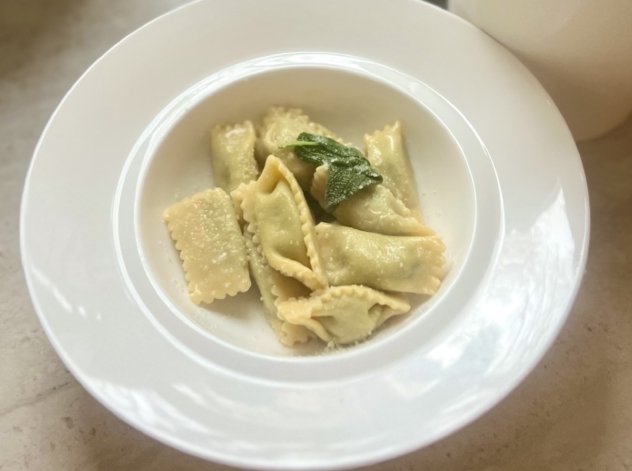
Giro d’Italia in 20 recipes
Gluten-free Agnolotti del Plin
Some regions tell their story through a single dish of filled pasta. And Piedmont, on this, has no doubts: Agnolotti del Plin—small, elegant, handmade ravioli, shaped with that precise and affectionate gesture that gives the recipe its name. Plin, in the local dialect, means “pinch”: the movement of the fingers that seals the pasta and encloses a filling rich in history.
For the Piedmont stage of my Giro d’Italia in 20 Recipes, I had a chat on Meet with Priscilla, who told me how much she has missed Agnolotti del Plin since living with coeliac disease.
Not so much because they can’t be made at home… but because they are hard to find in restaurants. And for someone who is coeliac, this often means giving up the very dishes that best represent local culinary traditions.
So here we are, facing a new challenge: bringing the magic of gluten-free Agnolotti del Plin to the table, while trying to preserve their true soul—the thin pasta, the flavourful filling, and the simple seasoning that lets the quality of the ingredients speak for itself.
This recipe is my way of saying to Priscilla (and to all of you): regional cuisine doesn’t have to become a “memory” after diagnosis. It can turn into a new possibility—more inclusive, and just as delicious.
I got to work with a clear goal in mind: a plin that seals well, holds up during cooking, and above all… tastes truly like Piedmont.
Agnolotti del Plin
32g carbohydrates per 100g
Ingredients for 4 servings
For the pasta:
- 120g wholegrain rice flour
- 35g potato starch
- 25g cornstarch
- 20g fine wholegrain corn flour
- 2 eggs
- 2g guar gum
- 1.5g xanthan gum
- 1 tablespoon oil
- Water, as needed
For the filling
(The quantity is double what you need, but given the long cooking time it’s a shame to make less. Alternatively, double the pasta and freeze the agnolotti you don’t use straight away.)
- 1 litre meat or vegetable stock
- 200g pork loin
- 200g veal
- 200g Swiss chard or spinach, blanched or sautéed (raw weight)
- 100g carrot
- 80g onion
- 80g celery
- 50g grated Parmigiano Reggiano
- 1 garlic clove
- 1 egg
- Nutmeg
- Salt
- Pepper
For dressing
- Grated Parmigiano Reggiano
- Butter
- Sage
**Ingredients specific for celiacs
*Ingredients whose labels must read “gluten-free” (or, in Italy, present on Prontuario AIC)
Preparation
- Start with the filling: cut the meat into pieces and brown it with a drizzle of oil in a casserole. Add the onion, celery and carrot, all chopped, along with the crushed garlic clove. Sauté for a few minutes, then season with salt and pepper to taste.
- Cook over low heat for about 2 hours, covered with a lid, adding hot stock when needed. Once cooked, let the meat cool completely. Transfer the meat and its cooking vegetables to a blender together with the Swiss chard, Parmigiano, egg and nutmeg. Blend until you obtain a soft but fairly dry mixture. Adjust seasoning and set aside.
- Prepare the pasta by combining all the dry ingredients with the eggs, a pinch of salt, the oil and enough water to form a smooth, homogeneous dough.
Wrap the dough in cling film and let it rest at room temperature for 30 minutes. - Once rested, start shaping the agnolotti: flatten a piece of dough with a rolling pin, dusting lightly with flour, then roll it out using a pasta machine to the desired thickness. I went to the second-to-last setting on my Imperia machine.
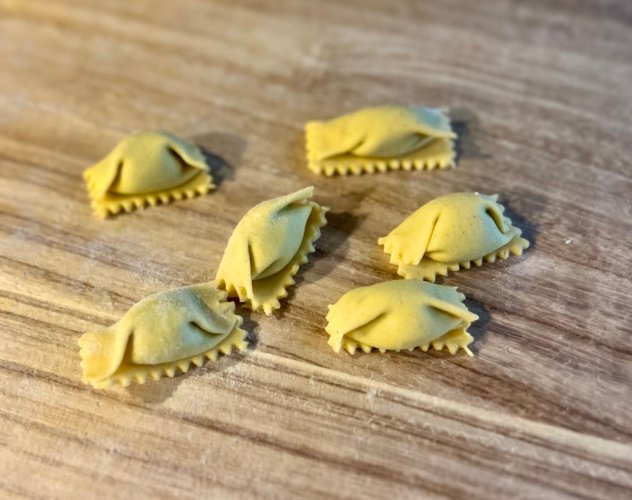
- Using a piping bag (or a teaspoon), place small hazelnut-sized mounds of filling on the pasta sheet, spacing them about 2 cm apart. Fold the sheet over the filling, press between the mounds and along the top to remove any air and seal well. Using a fluted pastry wheel, cut between the mounds and seal the edges with your fingers to form the agnolotti.
- Cook the agnolotti in boiling salted water for 3–4 minutes. Drain and toss them gently in a pan with melted butter and sage leaves for a couple of minutes. Serve hot, finished with a generous grating of Parmigiano Reggiano.